

Hydraulic Oil Viscosity: ISO VG 32 vs 46 vs 68 Selection Guide

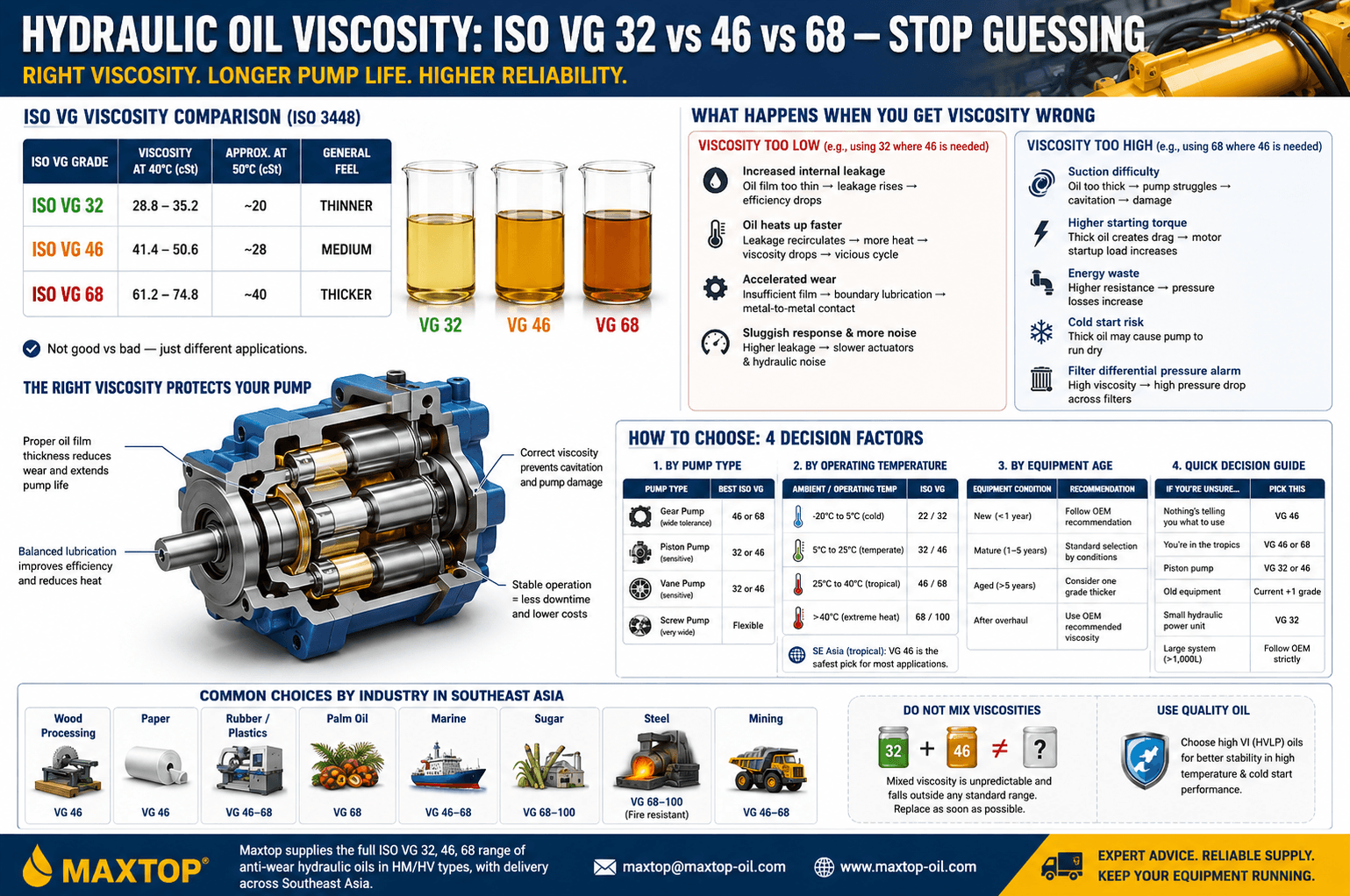
Hydraulic Oil Viscosity: ISO VG 32 vs 46 vs 68 — Stop Guessing
Last month in southern Vietnam, a pulp mill maintenance supervisor showed me his equipment logbook. Same model, same operating conditions — three units running different oil viscosities: 32, 46, and 68 mixed together.
I asked him why. He said: “We use whatever’s in the warehouse.”
Two of the units had their piston pumps fail soon after. Pump autopsy showed: the unit on VG 32 had an oil film too thin; the unit on VG 68 had the pump starving and cavitating. The unit on VG 46? Three years without a single issue.
Pick the right viscosity and your pump lives years longer. Pick wrong, and you’re looking at an overhaul.
What ISO VG Actually Means
ISO VG stands for ISO Viscosity Grade (ISO 3448), the standard classification system for industrial lubricant viscosity defined by the International Organization for Standardization. The number is based on the oil’s kinematic viscosity at 40°C.
| ISO VG Grade | Viscosity at 40°C (cSt) | Approx. at 50°C | General Feel |
|---|---|---|---|
| ISO VG 32 | 28.8 – 35.2 | ~20 cSt | Thinner |
| ISO VG 46 | 41.4 – 50.6 | ~28 cSt | Medium |
| ISO VG 68 | 61.2 – 74.8 | ~40 cSt | Thicker |
Key point: This isn’t “VG 32 is worse than VG 46.” It’s “32 suits one condition, 46 suits another.” Not good vs bad — just different applications.
What Happens When You Get Viscosity Wrong
Viscosity Too Low (e.g., using 32 where 46 is needed)
| Consequence | Mechanism |
|---|---|
| Increased internal pump leakage | Oil film too thin → piston pump internal leakage rises → volumetric efficiency drops |
| Oil heats up faster | Internal leakage recirculates → hydraulic energy converts to heat → oil gets hotter → viscosity drops further → vicious cycle |
| Accelerated component wear | Insufficient film thickness → boundary lubrication → metal-to-metal contact → wear |
| Sluggish system response | Higher internal leakage → actuator speed drops |
| Increased noise | Excessive pump internal leakage generates hydraulic noise |
Viscosity Too High (e.g., using 68 where 46 is needed)
| Consequence | Mechanism |
|---|---|
| Suction difficulty | Oil too thick → pump struggles to draw oil → cavitation → damage |
| Higher starting torque | Thick oil creates drag → motor startup load increases |
| Energy waste | Higher pipe resistance → pressure losses increase |
| Cold start risk | Cold, thick oil may cause pump to run dry |
| Filter differential pressure alarm | Excessive viscosity creates high pressure drop across filters |
How to Choose: 4 Decision Factors
1. By Pump Type
Different pumps have different viscosity sensitivity:
| Pump Type | Recommended Viscosity Range | Best ISO VG | Notes |
|---|---|---|---|
| Gear pump | 16–100 cSt | 46 or 68 | Wide tolerance; handles thicker oil |
| Piston pump | 10–40 cSt | 32 or 46 | Sensitive to viscosity; too thick = suction failure |
| Vane pump | 20–50 cSt | 32 or 46 | Sensitive; too thin = vane sticking |
| Screw pump | 10–200+ cSt | Flexible | Widest viscosity tolerance |
2. By Operating Temperature
| Ambient / Operating Temp | Recommended ISO VG | Reason |
|---|---|---|
| -20°C to 5°C (cold) | VG 22 / 32 | Good low-temperature flow |
| 5°C to 25°C (temperate) | VG 32 / 46 | — |
| 25°C to 40°C (tropical, like SE Asia) | VG 46 / 68 | High temps need thicker oil film |
| >40°C (extreme heat) | VG 68 / 100 | Maintain viscosity at extreme heat |
SE Asia field experience: For most of southern Vietnam, Thailand, Indonesia, and Malaysia, ISO VG 46 is the safest pick. Northern regions (northern Vietnam, highlands) can run VG 32 in winter and switch to VG 46 in summer.
3. By Equipment Age
| Equipment Condition | Recommendation | Reason |
|---|---|---|
| New (<1 year) | OEM-recommended viscosity | Precision clearances; follow the manual |
| Mature (1–5 years) | Standard selection by conditions | Clearances still within tolerance |
| Aged (>5 years) | Consider one grade thicker | Worn clearances; thicker oil compensates for internal leaks |
| After overhaul | Use OEM-recommended viscosity | Clearances restored to new |
Common Choices by Industry in Southeast Asia
| Industry | Typical Equipment | Recommended Viscosity | Reason |
|---|---|---|---|
| Wood processing | Hydraulic saws, planers, presses | VG 46 | Normal conditions |
| Paper | Hydraulic systems, calenders | VG 46 | Standard |
| Rubber / plastics | Injection molding machines | VG 46–68 | Hydraulic systems run hotter |
| Palm oil | Press hydraulic systems | VG 68 | Outdoor tropical heat |
| Marine | Deck hydraulics | VG 46–68 | Outdoor, hot, salt spray |
| Sugar | Mill hydraulics | VG 68–100 | Extreme heat operation |
| Steel | Continuous casting hydraulics | VG 68–100 (fire-resistant) | High temp + fire risk |
| Mining | Crusher hydraulics | VG 46–68 | Heavy load, frequent shocks |
Quick Decision Table
| If You’re Unsure… | Pick This | Why |
|---|---|---|
| Nothing’s telling you what to use | VG 46 | Most universal, safest choice |
| You’re in the tropics | VG 46 or VG 68 | Check OEM |
| Piston pump | VG 32 or VG 46 | Check OEM recommendation |
| Old equipment | Current viscosity +1 grade | Compensate for worn clearances |
| Small hydraulic power unit | VG 32 | Small systems have poor heat dissipation; low viscosity aids heat exchange |
| Large hydraulic system (>1,000L) | Strictly follow OEM | Don’t upgrade yourself; oil change costs are high |
FAQ
Can ISO VG 32 and 46 be mixed?
Best not to. After mixing, the viscosity is unpredictable and falls outside any standard range. Emergency short-term mixing is acceptable, but replace entirely as soon as possible.
How do I know which viscosity to use now?
Check the equipment manual first. If unavailable, go by pump type: piston pumps VG 32–46, gear pumps VG 46–68. Then factor in temperature: shift one grade thicker for tropical conditions.
In hot environments, is thicker always better?
No. Too thick → suction failure → cavitation. In high heat, choose a high viscosity index (VI) oil — like HVLP type — which resists thinning at high temperatures without sacrificing cold-start performance.
How soon can I tell the difference after changing viscosity?
Under normal conditions, immediately — pump noise, system response speed, and oil temperature will all change. If the change isn’t noticeable, the difference is within the system’s tolerance range.
My equipment nameplate is gone and the manual is lost. What now?
Check identical models in the factory (if any) for what they use. Or use our decision table: piston pumps = 32 or 46, gear pumps = 46, tropical outdoor = 46 or 68.
The Maxtop Advantage
When selecting hydraulic oil viscosity in Southeast Asia, unless there’s a clear OEM specification, ISO VG 46 is the least likely to be wrong starting point.
If you’re managing multiple production lines with mixed equipment models and long-lost manuals — send us your equipment list and operating conditions. We’ll recommend the right viscosity grade for each machine.
Maxtop supplies the full ISO VG 32, 46, 68 range of anti-wear hydraulic oils in HM/HV types, with delivery across Southeast Asia. View hydraulic oil products


