

Hydraulic Oil Temperature Too High? 4 Causes and Fixes

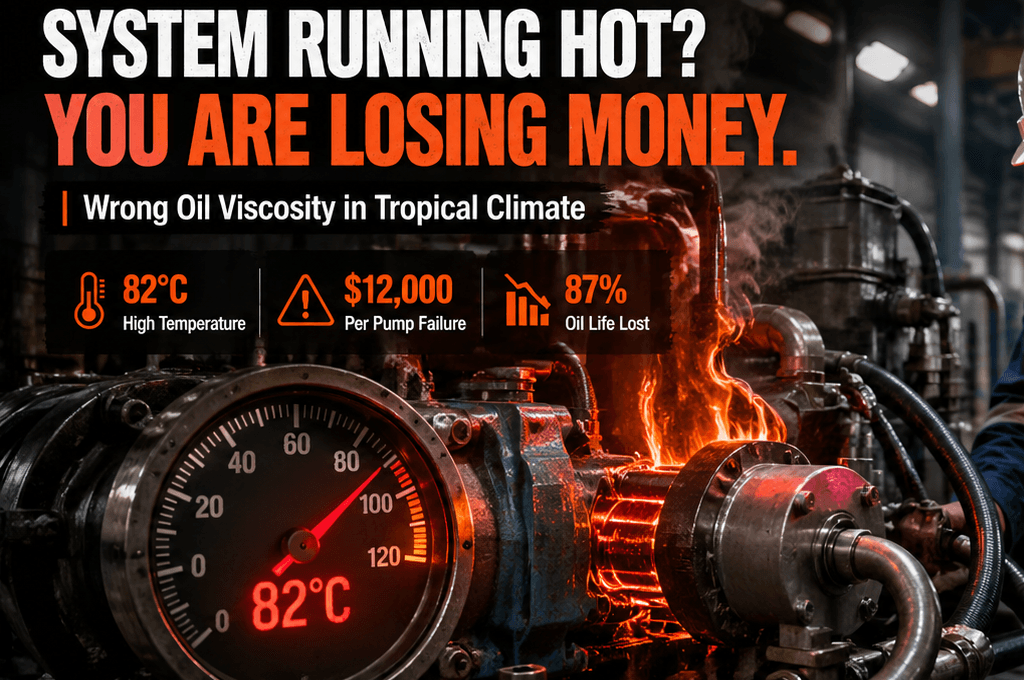
If your system is running hot, you are losing money. Here is why.
Last Tuesday. Indonesian textile factory. 2 PM.
The maintenance manager pulled me aside. “It hit 82°C yesterday. Two hours into the shift.”
He was not asking for a lecture. He was asking for help.
$18,000 in failed pumps last year. Three emergency shutdowns. The production manager had started looking at Chinese pumps because the German ones kept dying.
I looked at the temperature gauge. Then I looked at their oil can.
ISO VG 32.
Of course it was overheating.
The Real Problem (It Is Not What You Think)
Here is the thing nobody tells you:
The OEM manual is wrong for Southeast Asia.
That manual says ISO VG 32 is correct—if your factory is in Germany, where 25°C is a hot day.
In Jakarta? 35°C is what you have at 10 AM.
VG 32? That oil is as thin as peanut butter in summer.
| What is happening | What it looks like |
|---|---|
| Oil thins out | Less lubrication |
| Metal touches metal | Pump starts whining |
| Heat builds | Temperature rises |
| Pump dies | You buy a new one |
4 Things That Make Oil Run Hot
1. Wrong Viscosity (Most Common, Easiest Fix)
You know the easiest $500 fix I have ever done?
Told a plant in Thai Binh to switch from VG 32 to VG 46.
The Temperature dropped to 14°C on the first day.
They thought I was joking.
Two years later, they still have not changed a pump.
If you are in a tropical climate and using VG 32—you are gambling.
| Application | Temperate Climate | Tropical Climate |
|---|---|---|
| General industrial | ISO VG 32 | ISO VG 46 |
| Heavy-duty | ISO VG 46 | ISO VG 68 |
| High-pressure | ISO VG 46 | ISO VG 68 |
2. Low Oil Level
This one is embarrassing because it is so obvious.
Less oil = less cooling surface. Same heat, smaller sink.
“Minimum acceptable” is not “optimal.” It is just the point where things still kind of work.
Fix: Check the level daily. Not weekly.
3. Dirty Filters
I know. Filters are boring.
But I have never seen a clogged filter that did not cause overheating.
The pump works harder when it cannot push oil through. Harder work = more heat.
Fix: Change before they clog. Not after.
4. Weak Cooling
Air-cooled exchanger. Three years of dust on the fins.
You could not see the metal.
The fan was “running.” But it was moving maybe 30% of the air it should.
Two hours of cleaning. Temperature dropped 12°C.
Fix: Clean the fins. Monthly if you are in a dusty place.
The Numbers (Because Money Talks)
| Problem | What it costs you |
|---|---|
| Wrong VG + tropical heat | $12,000/pump failure |
| Running at 80°C | 87% oil life gone |
| Dirty filter | 20% extra energy |
| Every 10°C over 60°C | Half the oil life |
A plant manager in Surabaya told me:
“We spent $50,000 on pumps in two years. The solution was an oil grade change.”
FAQ
Q: What temperature is too hot?
Above 65°C = concerning. Above 80°C = shut it down.
Q: Will synthetic oil fix it?
Synthetic runs cooler, yes. But it will not solve the real problem.
Q: How do I know if my oil is wrong?
If you are in Southeast Asia and using VG 32—it is wrong.
Q: What should I check first?
Oil level. Then filters. Then cooler.
The Pattern
Heat comes → Oil thins → Pump works harder → Temperature rises → Pump dies → Buy new pump → Use same oil
It is not a mystery. It is usually four things:
- Right oil grade
- Right oil level
- Clean filters
- Clean cooler
Four things. Maybe $500 in parts.
Versus $12,000 in emergency pump replacement.
We will walk through what you have. No pitch. Just help.
Contact Maxtop:
Website: www.maxtop-oil.com
Email: maxtop@maxtop-oil.com


