

Hydraulic Oil Selection and Maintenance&The Complete Guide

Why Hydraulic Oil Selection Matters
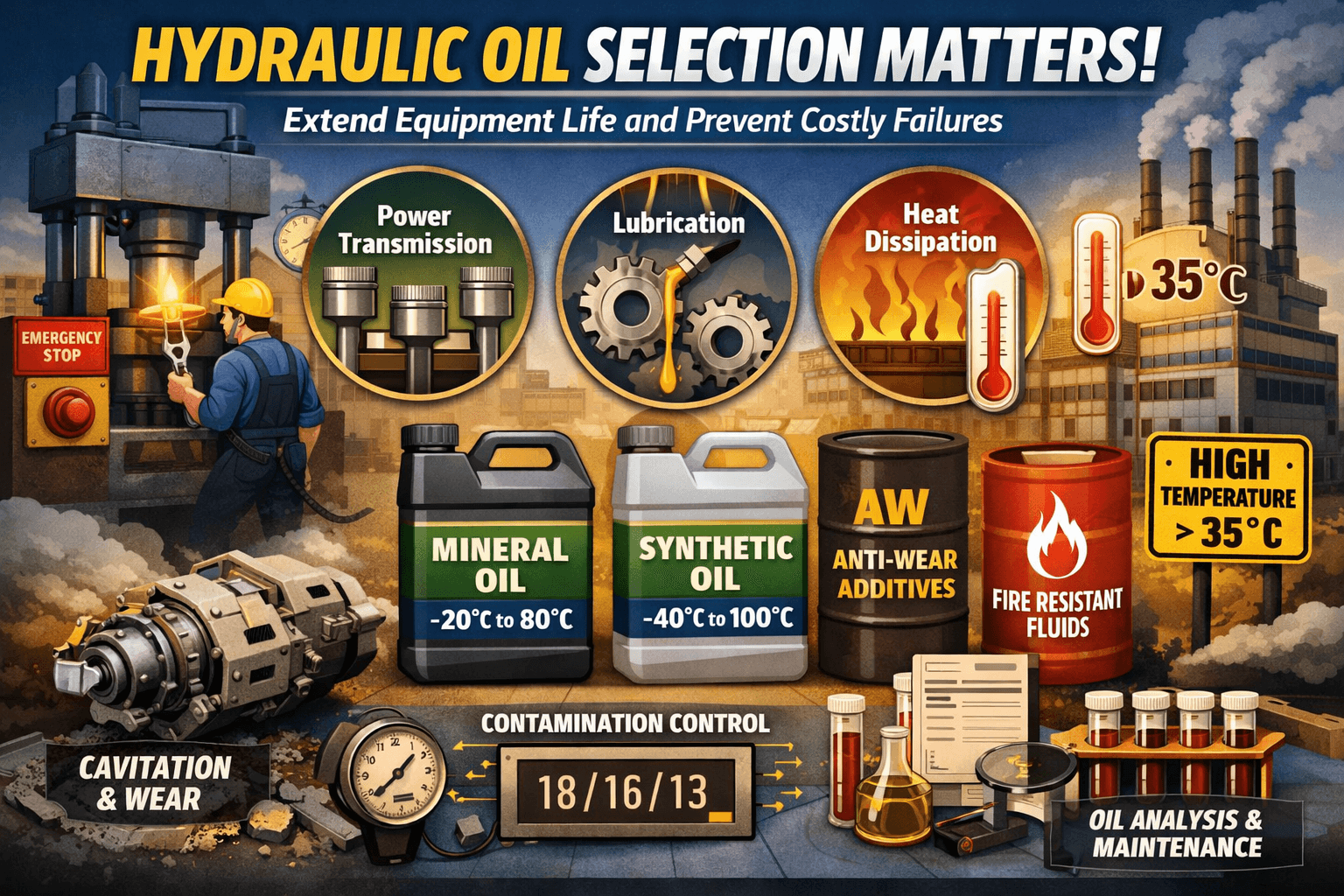
When a hydraulic press fails, the cost goes far beyond the repair bill. You are looking at production downtime, emergency orders, and overtime. In Southeast Asia, where temperatures regularly exceed 35°C, the wrong hydraulic oil can cut equipment life by half. This guide covers everything you need to select the right hydraulic oil for your industrial application.
Core Functions of Hydraulic Oil
Hydraulic oil does three critical jobs in your system:
- Power transmission — Converts mechanical energy to hydraulic energy
- Lubrication — Protects pumps, valves, and actuators from wear
- Heat dissipation — Carries heat away from components
The wrong oil causes cavitation and seizure in pumps ($5,000-50,000 repairs), reduced response time in control valves, increased energy consumption, and premature failures.
Types of Hydraulic Fluids
Mineral-Based Hydraulic Oil
The most common choice for general industrial applications. Temperature range: -20°C to 80°C. Service life: 2,000-4,000 hours. Best for standard industrial hydraulics and budget-conscious operations.
Synthetic Hydraulic Oil
Superior performance in extreme conditions. Temperature range: -40°C to 100°C+. Service life: 8,000-20,000 hours. Best for high-temperature environments, critical systems, and extended drain intervals.
Anti-Wear (AW) Hydraulic Oil
Contains ZDDP additives that form a protective film under high pressure. Essential for piston pumps and systems above 2,000 PSI.
Fire-Resistant Hydraulic Fluids
Required in high-risk environments like steel mills and foundries. Options include water-glycol, phosphate ester, and biodegradable HFD fluids.
ISO Viscosity Grade Selection
Viscosity is the most critical property. It determines film thickness, flow rate, and energy efficiency.
| ISO VG | Viscosity (cSt) | Common Applications |
|---|---|---|
| VG 15 | 13.5-16.5 | High-speed components |
| VG 22 | 19.8-24.2 | CNC machines |
| VG 32 | 28.8-35.2 | General industrial |
| VG 46 | 41.4-50.6 | Standard hydraulics |
| VG 68 | 61.2-74.8 | Heavy-duty systems |
| VG 100 | 90-110 | Large presses, mining |
Selection by Pump Type
- Gear pumps: Tolerate wider viscosity range (VG 32-68)
- Vane pumps: Require consistent viscosity (VG 32-46)
- Piston pumps: High pressure needs (VG 46-68)
Contamination Control
Contamination causes approximately 75% of all hydraulic system failures.
| Code | Particles/mL (≥4μm) | Application |
|---|---|---|
| 20/18/15 | 5,000-10,000 | New oil standard |
| 18/16/13 | 1,300-2,500 | Standard industrial |
| 16/14/11 | 320-640 | Critical systems |
| 14/12/10 | 40-80 | Precision servo |
Water contamination above 0.1% causes corrosion, additive depletion, and bacterial growth. Target cleanliness levels: Industrial hydraulic 18/16/13, mobile hydraulics 19/17/14, servo systems 16/14/11.
Maintenance Best Practices
Regular Inspection Schedule
Daily checks: Reservoir oil level, operating temperature, unusual noises, visible leaks.
Weekly: Oil level verification, pump pressure check, filter differential pressure.
Monthly: Oil sample analysis, filter element inspection, breathing element check.
Oil Analysis Program
Test quarterly for viscosity (±10% of new), TAN (below 0.3 mg KOH/g), water content (below 0.1%), and particle count.
Troubleshooting Common Problems
| Problem | Cause | Solution |
|---|---|---|
| High temperature | Wrong viscosity | Select correct VG grade |
| Noisy operation | Low oil level, air in system | Add oil, tighten fittings |
| Slow response | Internal leakage, pump wear | Inspect valves, rebuild pump |
| Foaming | Water contamination | Drain, flush, refill |
Frequently Asked Questions
Q1: Can I mix different brands of hydraulic oil?
Generally not recommended. Different additive packages may not be compatible, causing additive dropout, varnish formation, or reduced protection. Drain and flush the system if you must change brands.
Q2: How often should I change hydraulic oil?
Standard mineral oil: 2,000-4,000 hours. Synthetic oil: 8,000-20,000 hours. Severe conditions: Based on oil analysis. Use oil analysis to determine actual condition rather than relying on calendar intervals.
Q3: What happens if I use the wrong viscosity?
Too light (low VG): Thin film causes wear. Too heavy (high VG): Restricted flow causes cavitation. Always follow OEM specifications.
Q4: Can I use motor oil in my hydraulic system?
Never use motor oil in hydraulic systems. Motor oils contain detergent additives incompatible with hydraulic seals and may damage servo and proportional valves.
Q5: Why does my hydraulic oil turn brown?
Brown or dark oil indicates normal oxidation, overheating producing varnish, or metal particles catalyzing oxidation. Use oil analysis to determine if the oil still meets specifications.
Q6: What causes hydraulic oil to smell burnt?
Burnt odor indicates extreme overheating, extended service oxidation, or system malfunction. Change the oil immediately and investigate the root cause.
The Maxtop Advantage
Maxtop supplies industrial lubricants throughout Southeast Asia:
- Premium hydraulic oils — AW formulations for high-pressure systems
- Synthetic options — Extended service life and temperature range
- Biodegradable fluids — Environmental responsibility solutions
- Technical support — Expert guidance for your specific application
Contact our technical team to discuss your hydraulic oil requirements and develop a maintenance program that maximizes equipment reliability.
Contact Maxtop:
Website: www.maxtop-oil.com
Email: maxtop@maxtop-oil.com


