

Hydraulic Oil Selection for South American Mining & Heavy Industry: The 2026 Procurement & Engineering Guide

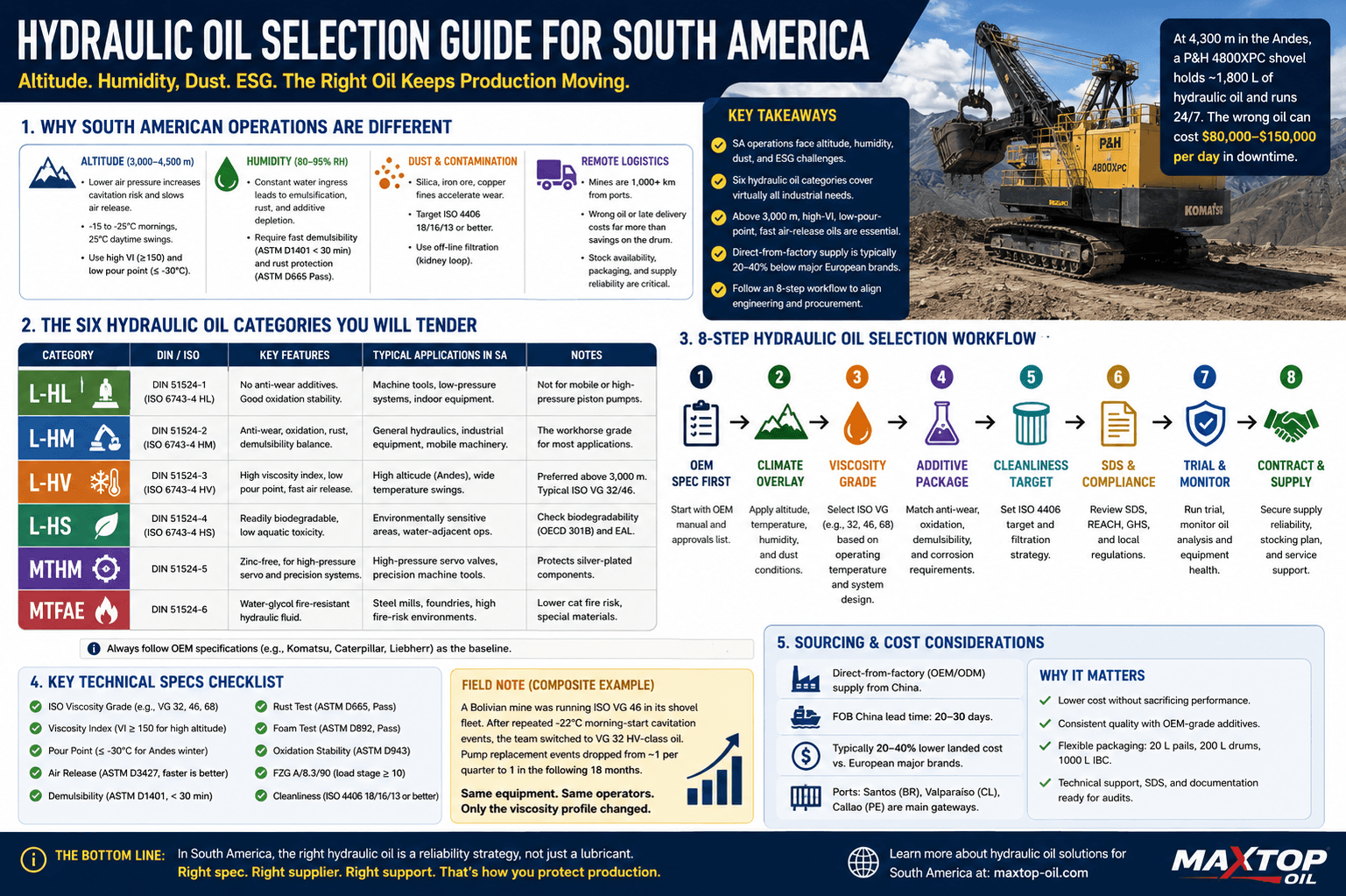
At 4,300 m above sea level in the Peruvian Andes, the Komatsu P&H 4800XPC class of ultra-class electric rope shovel (the same size machine often referenced on Antamina, Cerro de Pasco, and Collahuasi sites) holds roughly 1,800 litres of hydraulic oil per refill and runs 24/7 duty cycles that punish every weak spec in the procurement sheet. Get the hydraulic oil selection wrong on a machine like that, and the bill shows up fast. A new piston pump runs $5,000–$50,000 USD before idle time, and an ultra-class shovel idling for want of the right drum costs a mine $80,000–$150,000 a day.
This guide is written for two people at once. The maintenance engineer defending a viscosity grade against the OEM service manager. The procurement manager defending a supplier choice against the CFO. Both jobs happen on the same continent, often on the same site, and both face the same pressures: altitude, humidity, dust, ESG mandates, customs, currency swings, counterfeit drums. Most hydraulic-fluid guides in English were written for temperate, low-altitude factory floors and stop there. This one is built for the Andes at 4,000 m, the Carajás at 95% RH, and the lithium-brine sites where the procurement sheet has an ESG box to tick.
Key takeaways
- South American operations are not a generic industrial environment. Altitude, tropical humidity, iron-ore dust, and lithium-brine ESG rules each change the oil spec.
- There are six hydraulic-oil categories a serious SA tender should consider (L-HL, L-HM, L-HV, L-HS, MTHM, MTFAE). Picking the wrong one is the most expensive mistake a buyer can make.
- Above 3,000 m, your default oil changes. High-VI, low-pour-point, fast air-release fluids are no longer optional.
- Direct-from-factory OEM/ODM supply typically lands in Santos, Valparaíso, or Callao 20–40% under European major brands, with 20–30 day FOB China lead times.
- An eight-step selection workflow (OEM spec → climate overlay → ISO VG → additive → cleanliness → SDS → trial → contract) is the simplest way to keep engineering and procurement aligned.
1. Why South American Operations Are a Different Hydraulic-Fluid Problem
Most hydraulic-fluid buying guides in English were written for temperate, low-altitude, dust-controlled factory environments. South American heavy industry is none of those. Chile, Peru, Brazil, Argentina, Colombia, Ecuador, and Bolivia stack four environmental stresses on the same machine: altitude, humidity, dust, and ESG. The sections below diagnose each one; the rest of the guide turns the diagnosis into a defensible spec.
1.1 Altitude: the Andes derating nobody talks about
At 3,500–4,500 m, atmospheric pressure drops to roughly 60–65% of sea level. Pump cavitation risk rises because the fluid boils at a lower absolute pressure, and air-release time for a standard HM oil can double. Winter morning starts at Antamina (~4,300 m), Collahuasi (~4,440 m), Cerro de Pasco (~4,380 m), and the Bolivian altiplano drop to -15 to -25°C, while daytime ambient can swing 25°C. That diurnal range is what high-VI (≥150) and low-pour-point (≤ -30°C) fluids were built for. The standard HM 46 you used at the coastal port will not behave the same at 4,000 m.
Field note (composite example). A maintenance supervisor at a Bolivian polymetallic mine had been running ISO VG 46 in his shovel fleet for years. Two winters ago, after a string of -22°C morning-start cavitation events on piston pumps, his team switched to a VG 32 HV-class oil. Pump-replacement events dropped from roughly one per quarter to one in the following 18 months. Same equipment, same operators, same OEM. Only the viscosity profile matched to the climate.
1.2 Tropical heat and humidity: the equatorial belt
In the Brazilian Amazon belt (Carajás in Pará, the Tubarão and Ponta da Madeira iron-ore ports), the Colombian coal belt (Cerrejón, Drummond), and the Ecuadorian coastal oilfields, relative humidity sits at 80–95% for most of the year and ambient rarely falls below 25°C. Water ingress into the reservoir is constant. Once water emulsifies, the additive package is compromised, rust follows, filter life collapses. Demulsibility (ASTM D1401, < 30 min) and rust prevention (ASTM D665, pass) move from “nice to have” to mandatory. A coastal Brazilian plant can get away with a relaxed demulsibility spec; a Carajás shovel cannot.
1.3 Dust, silica, and ISO 4406 cleanliness
Open-pit copper in the Atacama, iron-ore in Carajás, and lithium evaporation ponds all generate aggressive particulate contamination: silica, iron-ore fines, copper concentrate. For high-pressure piston pumps in excavators and shovels, target ISO 4406 18/16/13 or better, with off-line kidney-loop filtration on machines that cost more than the skid protecting them. Treat the filter element as a wear item. In SA dust, it usually is.
1.4 Remote-site logistics and inventory cost
A major SA mine can sit 1,000+ km from the nearest container port. When the wrong grade arrives, or the right grade arrives late, the production loss dwarfs the savings on the drum. Procurement is never just $/L. It is reliability of supply, local stockholding, drum and IBC availability, and the option of direct-from-factory replenishment. The Maxtop solutions hub walks through that supply model.
2. The Six Hydraulic Oil Categories You Will Actually Tender
The taxonomy below is what a serious South American RFQ uses. DIN 51524 and ISO 6743-4 are the global backbone; two of the six (MTHM and MTFAE) reflect what SA buyers increasingly specify for high-pressure servo systems and ESG-mandated fire-resistant service. If your current shortlist does not name at least five of these, it is a brochure, not a tender.
2.1 L-HL: machine-tool and general hydraulic oil
DIN 51524 Part 1, no anti-wear (AW) additives. Indoor machine shops, low-pressure presses, general plant hydraulics. Not suitable for mobile mining equipment or any high-pressure piston-pump circuit. Cheaper per litre, but the wrong spec for any machine that is dragging a load uphill.
2.2 L-HM: anti-wear hydraulic oil (the workhorse)
DIN 51524 Part 2 with AW additives (ZDDP or ashless). The default for roughly 70% of South American industrial hydraulics: excavators, wheel loaders, presses, machine tools, injection moulding. Maxtop L-HM Anti-Wear Hydraulic Oil covers ISO VG 32 / 46 / 68 and is the SKU most SA procurement teams will use as their default reference.
2.3 L-HV: high-viscosity-index low-temperature hydraulic oil
DIN 51524 Part 3, VI ≥ 150, pour point ≤ -30°C. Built for cold morning starts and large diurnal swings. South of Patagonia, on Bolivian winter mornings, and on Andean high-altitude sites, HV is the right call, not HM. The Maxtop L-HV Cryogenic Hydraulic Fluid covers this category.
L-HM vs L-HV at a glance
| Spec | L-HM (anti-wear workhorse) | L-HV (cold-duty high-VI) |
|---|---|---|
| DIN 51524 part | Part 2 | Part 3 |
| Viscosity index (VI) | ≥ 90 (standard mineral) | ≥ 150 (high-VI base) |
| Pour point | -15 to -24°C typical | ≤ -30°C |
| Best ambient | 0 to 40°C, factory / mobile | -20 to 35°C with diurnal swing |
| Best use case | Excavators, presses, mobile, ~70% of SA industrial hydraulics | Andean high-altitude shovels, Patagonian oilfields, altiplano winter |
| Add-on cost vs L-HL | +20 to 30% | +40 to 70% (base oil + additive) |
| SA failure mode avoided | Cavitation at altitude, sluggish cold-start | Same as L-HM, plus low-temp pump starvation |
2.4 L-HS: ultra-low-temperature hydraulic oil
DIN 51524 Part 3, pour point ≤ -45°C. Patagonian oilfields, high-altitude Andean winter, LNG/aviation ground support. The Maxtop L-HS Ultra-Low Temperature Hydraulic Oil is the spec for these environments.
2.5 MTHM: high-pressure ashless anti-wear hydraulic oil
DIN 51524 Part 2, ashless AW chemistry. For servo-valve systems, precision injection moulding, modern hydraulic presses, and the latest Cat and Komatsu mobile electronics where ZDDP ash would poison the system. Ashless does not mean “no protection”. It means non-ash chemistry that does not leave conductive deposits on servo-valve spools, a real failure mode in modern high-pressure circuits. The Maxtop MTHM High-Pressure Ashless AW Hydraulic Oil covers this category.
2.6 MTFAE: fatty-acid-ester fire-resistant hydraulic oil (HFDU)
ISO 6743-4 HFDU family. For steel plants, foundries, underground mining, hot-work areas, and turbine governing. Increasingly specified in ESG-driven SA mining where biodegradable, low-toxicity fluids are mandated near water tables. The Maxtop MTFAE Fatty Acid Ester Fire-Resistant Hydraulic Oil is the HFDU play in this taxonomy.
| Maxtop SKU | DIN / ISO category | Best-fit South American use case |
|---|---|---|
| L-HL Hydraulic Oil 10# | DIN 51524-1 L-HL | Low-pressure machine tools, indoor presses (low-VG grade for cold-start light duty) |
| L-HM Anti-Wear Hydraulic Oil | DIN 51524-2 L-HM | Default workhorse for ~70% of SA industrial hydraulics |
| L-HV Cryogenic Hydraulic Fluid | DIN 51524-3 L-HV | Andean high-altitude winter starts, diurnal swing sites |
| L-HS Ultra-Low Temperature Hydraulic Oil | DIN 51524-3 L-HS / extreme-pour | Patagonian, altiplano winter, LNG ground support |
| MTHM High-Pressure Ashless AW Hydraulic Oil | DIN 51524-2 L-HM ashless | Servo valves, modern mobile electronics, precision presses |
| MTFAE Fatty Acid Ester Fire-Resistant (HFDU) | ISO 6743-4 HFDU | Underground mining, foundries, lithium-brine ESG sites |
| Maxtop MT4119 (factory designation) | L-HM, ISO VG 46 | OEM-ODM private label, custom drum and IBC configurations |
Note: Maxtop’s 10# grade (low-viscosity L-HL) and the MT4119 OEM-ODM code are commonly referenced in tender packs for indoor machine-tool service and distributor private-label contracts. Both sit inside the six-category taxonomy above.
3. Viscosity Stage of Hydraulic Oil Selection: ISO VG Decision Matrix for SA Conditions
Viscosity is the most consequential choice in the selection. Wrong viscosity causes more than 50% of hydraulic system failures (Haichen Industry 2026, corroborated by Noria and Machinery Lubrication). For piston pumps, the minimum acceptable operating viscosity is 10 cSt, with an optimum around 16 cSt. Below that, the pump starves; above 40 cSt, the system overheats and cavitates. Altitude and humidity move viscosity around more than any other variable, so the spec has to be re-checked when a machine relocates from a coastal plant to an Andean site.
3.1 The pump-and-temperature matrix
- Piston pumps: 10–40 cSt optimum. VG 32 (cold duty), VG 46 (general), VG 68 (hot and heavy load).
- Vane pumps: 16–35 cSt optimum. VG 46 is the safe default.
- Gear pumps: 20–80 cSt. VG 68 for hot, slow, high-pressure circuits.
3.2 The South America climate overlay
| ISO VG grade | cSt @ 40°C | Pump type | Climate / altitude | Example SA use case |
|---|---|---|---|---|
| VG 32 | 32 | Piston, vane (light duty) | Cold ambient, 0–25°C, high-altitude morning starts | Andean shovel hydraulic system, Patagonian oilfield |
| VG 46 | 46 | Piston, vane (general), gear (light) | Temperate 20–35°C, most factory and mobile duty | Brazilian industrial plant, Chilean coastal port equipment |
| VG 68 | 68 | Piston (heavy), gear, vane (heavy) | Hot 30–40°C, high ambient, heavy load | Carajás open-pit haul-truck hydraulics, foundry presses |
| HV 32 | 32 (VI ≥ 150) | Piston, vane | High-altitude + cold morning start | Andean high-altitude shovels and excavators, Bolivian altiplano winter |
| HV 46 | 46 (VI ≥ 150) | Piston, vane | General industrial with diurnal swing | Chilean Atacama copper concentrator with 25°C day / 5°C night |
A side note for procurement. The VG 32 vs VG 46 vs VG 68 viscosity decision is one most buyers face every quarter. The full reasoning, with pump-by-pump minimum-viscosity tables, is in our hydraulic oil viscosity selection guide. Use that as the deep-dive, this section as the regional overlay.
3.3 The OEM-trumps-everything rule
Always defer to the equipment manual first. If the OEM spec is generic or unavailable (common for older SA fleets), fall back to the matrix above, then to the climate overlay, then to §6. The matrix is the secondary tool, not a replacement for the OEM letter.
4. The Four Contamination Threats Unique to SA Sites
Maintenance engineers in temperate climates fight one or two contamination modes at a time. SA sites usually fight all four, often on the same machine. The fix is to spec for all four in the RFQ, not to wait for a failure.
4.1 Water: humidity, rainfall, and condensation
Spec demulsibility (ASTM D1401 < 30 min) and add a water-separation check to incoming QA. The Maxtop hydraulic oil contamination warning-signs guide covers the symptom-side checklist.
4.2 Particulate: silica dust, iron-ore fines, copper concentrate
Target ISO 4406 18/16/13 or better for piston pumps. Specify off-line kidney-loop filtration for ultra-class shovels and excavators, and treat the filter element as a wear item, not a maintenance interval. In SA dust, the element usually wears out before the scheduled change.
4.3 Heat: continuous high ambient and slow equipment speed
Specify HV-class oils and confirm oxidation stability (ASTM D943 > 1,000 h). Continuous high ambient shortens drain intervals: synthetic HV fluids can still hit 8,000–16,000 service hours, but in severe SA service that drops to 4,000–8,000. Build that into the contract, not into the first quarterly oil analysis.
4.4 Air and foam: altitude and tank design
Specify air release (ASTM D3427) < 5 min for Andean operations. Foam-suppressant additives are mandatory. The altiplano and Atacama will punish anything else with pump starvation on the first cold morning start.
5. Standards, Specs, and the Procurement Vocabulary You Need
Procurement: forward §5.3 to your finance lead before the next tender cycle. The 20–40% landed-cost differential versus European majors is the line item your CFO will want in the model. Maintenance: this section turns your spec into a defensible RFQ.
Most SA RFQ rejections come down to missing paperwork, not missing performance. The standards below are the ones a serious buyer should be able to cite by clause, in the same sentence as the supplier’s brand name.
5.1 The four specs buyers actually demand
- ISO 6743-4 and DIN 51524 Parts 1–3: the global baseline for HL, HM, HV, and HS classification. [DIN 51524](https://www.din.de/en/getting-involved/standards-committees/nmp/standards) is the anchor most SA RFQs reference.
- ISO 3448: industrial fluid viscosity grade.
- ASTM battery: D1401 demulsibility, D665 rust, D943 oxidation, D3427 air release, D2270 VI.
- OEM approvals: Bosch Rexroth, Parker Denison, Eaton, Komatsu, Caterpillar, Liebherr. The OEM letter is the procurement manager’s warranty insurance.
5.2 What SA procurement RFQs typically include
Viscosity grade, additive package (ashless vs ZDDP), VI minimum, pour-point maximum, cleanliness code, OEM approval list, drum/IBC/bulk packaging, EN + CN SDS, factory-audit clause. If the spec sheet does not name each, you are not comparing suppliers. You are comparing brochures. See our ISO/DIN standards guide.
5.3 Where the Chinese OEM/ODM supply curve wins
Direct factory pricing is typically 20–40% under European majors for equivalent spec. Lead times are 20–30 days FOB China versus 45–60 days from EU/US. SDS comes in EN and CN by default; ES and PT available for ANP, SEC, and MINEM filings. OEM/ODM customization (private label, viscosity tuning, drum and IBC size) is standard service. The SDS download shortens the QA cycle. MOQ: 200 L trial drum to 20,000 L bulk. On 12-month contracts, payment terms are negotiable: LC at sight, LC 30/60/90, or TT 30/70.
Landed-cost worked example. A 1,000 L IBC of L-HM 46 delivered to Carajás lands at 1.4–1.6× FOB drum price, all-in (sea freight + ICMS + port handling + inland truck). Valparaíso and Callao: 1.3–1.5× FOB. For a written estimate, send your equipment list, viscosity grade, and target port to the Maxtop quotation team. One-business-day response with per-litre breakdown, FOB schedule, and OEM-approval cross-check.
Sidebar: counterfeit and grey-market risk. Brazilian ANP and Chilean SEC have both warned about counterfeit and diluted hydraulic oil in the SA aftermarket. Defence: verify batch CoA against the supplier’s CoA, request OEM authorization letters, and, when volume justifies it, commission a third-party audit. Audits (SGS, Bureau Veritas, TÜV) are welcomed. Direct-from-factory supply is the structural fix. Vetting playbook: selection-mistakes guide.
5.4 Currency and contract structure
BRL, ARS, CLP, and PEN are all volatile against USD. A 12-month supply contract priced in USD with a local-currency settlement option, indexed to a published base-oil benchmark, is a sensible hedge. It insulates the operations budget from short-term FX swings while keeping the supplier willing to hold safety stock. Lock the price index before the first drum, not after.
6. Step-by-Step Selection Workflow
This is the workflow an SA maintenance engineer can hand to a procurement manager, and vice versa. Eight steps, each with a deliverable.
- Identify the OEM spec. Pull it from the equipment book, the data plate, or the dealer. Record ISO VG, DIN 51524 category, OEM approval list.
- Map the operating environment. Altitude (m), ambient temperature range (°C), dust load, humidity (%), proximity to water tables, fire-risk zones.
- Pick the ISO VG grade. Use the matrix in §3. Confirm with the OEM if the spec is generic.
- Choose the additive package.L-HM standard, L-HV cold, MTHM ashless for servo valves, MTFAE ester for fire-resistant and ESG service.
- Set the cleanliness target. ISO 4406 code, filtration spec (β ratio), and off-line kidney-loop if justified.
- Confirm SDS, OEM approvals, and packaging.Drum, IBC, or bulk; EN + CN SDS available; OEM approval letters on file.
- Run a 90-day trial with quarterly oil analysis.TAN, viscosity @ 40°C, particle count, water by Karl Fischer. Compare against the supplier’s baseline data.
- Lock a 12-month volume contract with 30 days of safety stock at the remote site.Index price to a published base-oil benchmark, settlement in USD with local-currency option.
OEM-approval cross-check
| OEM | L-HM | L-HV | L-HS | MTHM | MTFAE |
|---|---|---|---|---|---|
| Bosch Rexroth | ✓ | ✓ | ✓ | ✓ | — |
| Parker Denison | ✓ | ✓ | — | ✓ | — |
| Eaton | ✓ | ✓ | — | ✓ | — |
| Komatsu | ✓ | ✓ | ✓ | ✓ | — |
| Caterpillar | ✓ | ✓ | ✓ | ✓ | — |
| Liebherr | ✓ | ✓ | ✓ | — | — |
Empty cells: no defensible approval letter yet. Request the current approval file for your shortlist via the CTA below.
CTA: practical next step. Request a custom hydraulic oil quotation with your equipment list and altitude. One-business-day response with a recommended Maxtop SKU, factory CoA, and OEM-approval cross-check.
Sample-drum risk-reversal: if the first drum fails your incoming-QA against the OEM approval list, we replace or refund. Your call.
7. South America–Specific FAQs
Q1: What hydraulic oil is best for high-altitude Andean mining (3,500 m+)? HV or HS class, VI ≥ 150, pour point ≤ -30°C (≤ -45°C for Patagonian or extreme altiplano winter). L-HV 32 is the typical piston-pump recommendation; default to HV at altitude for ultra-class shovels and excavators after OEM confirmation.
Q2: Can I use the same hydraulic oil in a Cat 793F haul truck and a Komatsu PC2000 excavator? Often yes, if both OEMs accept the same DIN 51524 category and additive package. Match each machine’s viscosity to its manual (VG 46 in the truck, VG 46 or VG 68 in the excavator). Shared bulk tanks work when specs line up; when they don’t, separate inventory is cheaper than a warranty fight.
Q3: Is biodegradable hydraulic oil mandatory in Chile or Peru yet? Not by law, but ESG-driven procurement at SQM, Albemarle, Codelco, Anglo American, and most lithium and copper juniors now lists HEES, HFDU, and MTFAE-class fluids as a checkbox on RFQs near water tables, brine ponds, and tailings. The spec is the procurement manager’s call; the additive package defence is the maintenance engineer’s.
Q4: How do I compare Chinese OEM hydraulic oil against Mobil DTE or Shell Tellus? Spec for spec. Pull the OEM approval list, additive chemistry, ASTM results, and SDS. A qualified Chinese OEM (Maxtop included) matches the spec at 20–40% lower landed cost and shorter lead time. The European brand premium covers R&D and global logistics, not necessarily better additive chemistry. Verify the SDS and OEM letter, not the brochure.
Q5: What’s the real delivered cost per litre importing from China to Santos or Valparaíso? FOB drum + sea freight (20–30 days) + ICMS or IVA or IGV + port handling + inland freight. All-in delivered to a Brazilian iron-ore site is typically 1.4–1.7× FOB. Consolidated shipping is the lever. See §5.3 for a worked example to Carajás, Valparaíso, and Callao.
Q6: How often should I change hydraulic oil in a continuous-operation SAG mill or shovel? Mineral oil: 2,000–4,000 h standard, cut by 50% in severe SA service. Synthetic HV: 8,000–16,000 h standard, 4,000–8,000 in severe service. Use oil analysis (TAN, viscosity @ 40°C, particle count, water by Karl Fischer), not the calendar. Maxtop’s mining and heavy-industry solutions cover the application side.
8. Conclusion: From the Andes to Your Next Drum
The Komatsu P&H 4800XPC class of ultra-class shovel operating in the Andes is the most visible symbol of the new South American hydraulic-fluid reality: bigger machines, higher altitudes, longer duty cycles, tighter ESG constraints, and a procurement environment where the wrong supplier is more expensive than the wrong spec. The eight-step workflow in §6 turns that complexity into a defensible decision for both engineering and procurement.
The South American heavy-equipment market is not a generic industrial market with a regional accent. It is its own engineering and procurement environment. Use the six categories, the viscosity matrix, the contamination checklist, and the standards vocabulary above, and you will land on a spec and supplier that can defend itself in front of the OEM service manager and the CFO at the same time. That is what correct hydraulic oil selection looks like in 2026 South American mining and heavy industry.
Next step. Send your equipment list, altitude, and duty cycle to the Maxtop quotation team for a recommended Maxtop SKU, OEM-approval cross-check, and 12-month landed-cost estimate. One-business-day written response; sample drums on the next consolidated sailing to Santos, Valparaíso, or Callao.
Sample-drum risk-reversal: if the first drum fails your incoming-QA against the OEM approval list, we replace or refund. Your call.


