

Hydraulic Oil Classifications: Comprehensive Guide to the Latest ISO/DIN Standards

What Is Hydraulic Oil
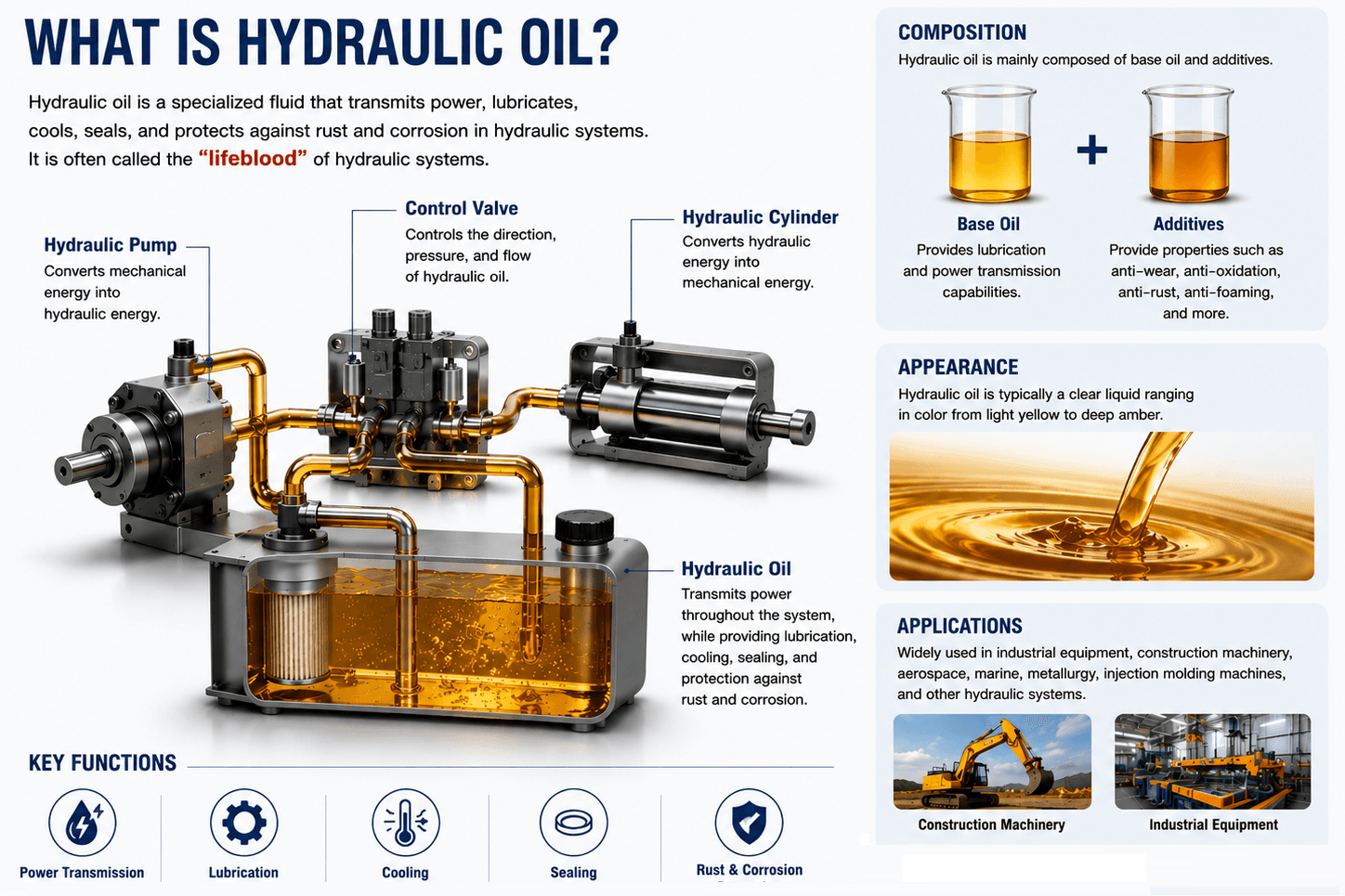
Hydraulic oil is the medium that transmits power in hydraulic systems. It also provides lubrication, heat dissipation, corrosion protection, and sealing.
Core requirements for hydraulic oil:
- Good lubrication properties
- High oxidation resistance
- Low viscosity change with temperature
- High flash point, low pour point
- Compatible with seals and gaskets
- Low compressibility
Hydraulic oils are classified into four main categories by base fluid type: mineral oil-based, fire-resistant, biodegradable, and water-based.
Mineral Oil-Based Hydraulic Oil (ISO 6743-4 / DIN 51524)
Mineral oil-based hydraulic oil is the most widely used type, accounting for over 85% of global hydraulic fluid consumption. Made from refined mineral oil with additives for different operating conditions.
| Classification | DIN Designation | Properties | Typical Application |
|---|---|---|---|
| HH | — | Pure mineral oil, no additives | Rarely used |
| HL | HL | Corrosion and oxidation inhibitors | General industrial hydraulics |
| HM | HLP | HL + anti-wear additives (ZDDP) | Medium to high pressure systems |
| HV | HVLP | HM + high viscosity index (VI>140) | Outdoor equipment with wide temperature range |
| HR | — | HL + viscosity index improver | Low-temperature environments |
| HG | — | HM + anti-stick-slip additives | Guideway hydraulic systems |
| HLPD | HLPD | HLP + detergent/dispersant | Contaminated environments, high moisture |
HLP is the most common grade in practice. If you use hydraulic oil in Southeast Asia, you most likely need HLP or HVLP.
HVLP vs HLP: HVLP has a higher viscosity index, meaning viscosity stays more stable when temperature changes. For outdoor equipment in Southeast Asia (excavators, cranes, etc.), HVLP is recommended.
Fire-Resistant Hydraulic Fluids
In high-temperature, open flame, or spark environments, mineral oil-based fluids present a fire risk. Fire-resistant fluids are used in metallurgy, foundries, mining, and similar applications.
| Classification | Composition | Water Content | Temperature Range | Notes |
|---|---|---|---|---|
| HFAE | Oil-in-water emulsion | >80% | +5 to +55°C | Low cost, poor lubricity |
| HFAS | Synthetic concentrate solution | >80% | +5 to +55°C | No separation risk, higher corrosion |
| HFB | Water-in-oil emulsion | >40% | +5 to +60°C | Rarely used |
| HFC | Water glycol | >35% | -20 to +60°C | Most common fire-resistant type, up to 250 bar |
| HFD-R | Phosphate ester | 0% | -20 to +150°C | High temperature, seal compatibility required |
| HFD-U | Fatty acid ester | 0% | -20 to +150°C | Lower density, better pump suction |
HFC is the most commonly used fire-resistant hydraulic fluid. If you are not sure which fire-resistant fluid to choose, it is most likely HFC.
Biodegradable Hydraulic Fluids
Used in environmentally sensitive areas: water protection zones, forestry, offshore platforms, snow grooming equipment. Low environmental impact in case of leaks.
| Classification | Base Oil | Characteristics |
|---|---|---|
| HETG | Triglyceride (vegetable oil) | Low cost, poor oxidation stability |
| HEES | Synthetic ester | Best balance of performance and biodegradability |
| HEPG | Polyglycol | Good low-temperature performance |
| HEPR | Poly-alpha-olefin and others | Good compatibility |
HEES is the most commonly used biodegradable hydraulic fluid. Synthetic ester base offers the best balance between biodegradability and performance.
Water-Based Hydraulic Fluids
Water was the first hydraulic medium. Pure water provides no lubrication or corrosion protection, so it is rarely used directly in industrial hydraulics. Usually mixed with oil to form emulsions.
| Type | Characteristics |
|---|---|
| Tap water (filtered) | No corrosion protection, special applications only |
| Technical water (water-oil emulsion) | Similar to cutting fluid, separation issues |
| Sea/salt water | Highly corrosive, not recommended |
ISO Viscosity Grades (ISO 3448)
Hydraulic oil viscosity is expressed as ISO VG (Viscosity Grade), which defines the kinematic viscosity range at 40°C.
| ISO VG | Viscosity at 40°C (cSt) | Typical Application |
|---|---|---|
| VG 15 | 13.5-16.5 | Ultra-high speed, low-temperature systems |
| VG 22 | 19.8-24.2 | High-speed, low-pressure systems |
| VG 32 | 28.8-35.2 | General industrial hydraulics (temperate climate) |
| VG 46 | 41.4-50.6 | Standard mobile equipment (recommended for tropics) |
| VG 68 | 61.2-74.8 | Heavy-duty industrial presses |
| VG 100 | 90-110 | Slow-speed, ultra-high pressure systems |
Southeast Asia recommendation: VG 46 (general duty) or VG 68 (heavy duty). VG 32 is too low viscosity for tropical climates.
Standards Quick Reference
| Standard | Content | Scope |
|---|---|---|
| ISO 6743-4 | Hydraulic oil classification system | All hydraulic fluids |
| ISO 3448 | Viscosity grade definitions | All industrial lubricants |
| DIN 51524 | HLP/HVLP performance requirements | German standard, used globally |
| ISO 11158 | HM/HV performance requirements | International standard |
| CETOP RP 91H | Hydraulic oil selection guide | European equipment |
About Maxtop
Maxtop offers hydraulic oil product lines that comply with ISO and DIN standards:
- HLP Series (ISO VG 32/46/68) — Standard anti-wear hydraulic oil
- HVLP Series (ISO VG 32/46/68) — High viscosity index for tropical outdoor equipment
- HEES Series — Biodegradable hydraulic oil


