

Heat Transfer Fluid: Synthetic vs Mineral Oil Comparison

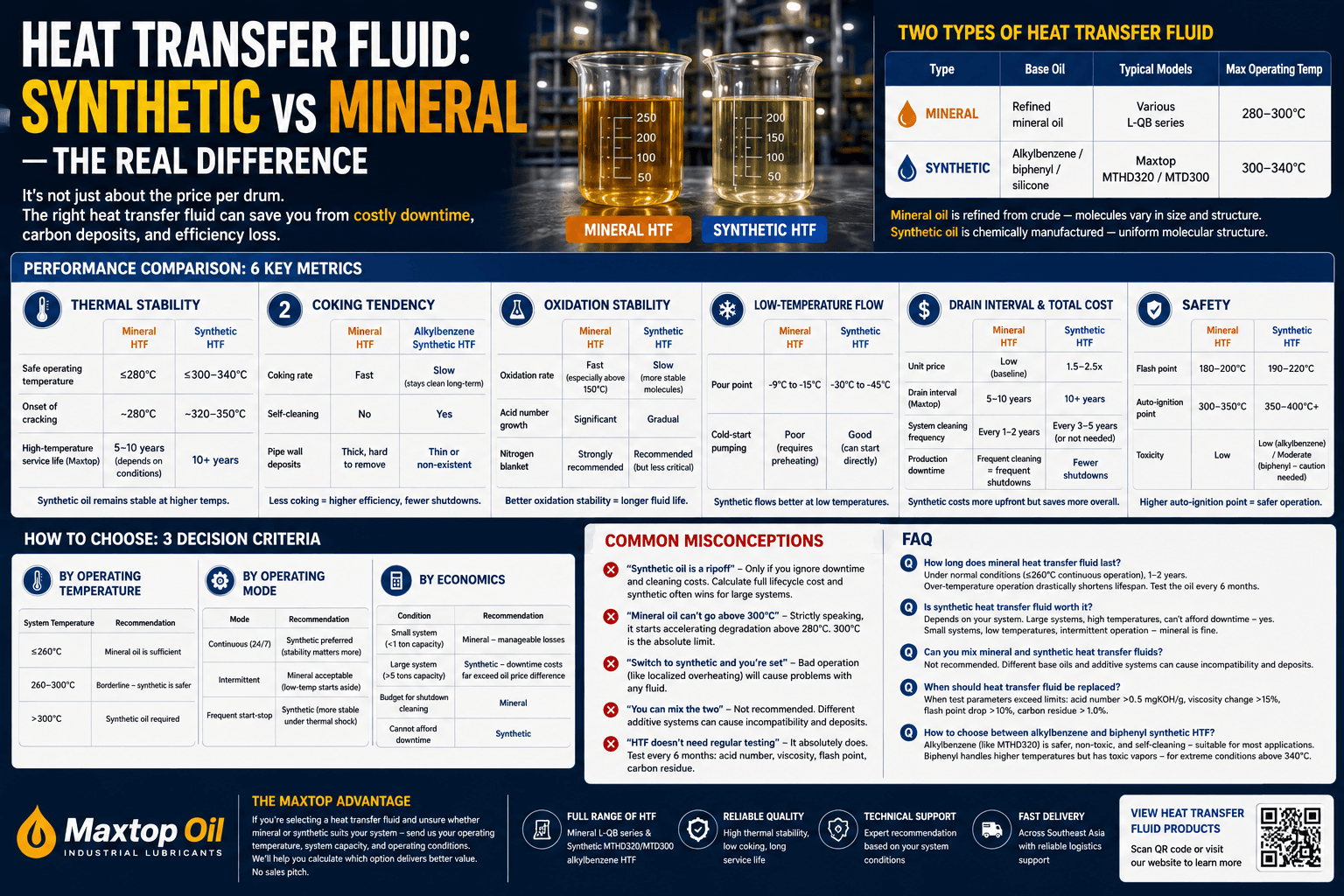
Synthetic vs Mineral — The Real Difference
Last year in Jakarta, I met a chemical plant engineer who complained that after three years on mineral heat transfer fluid, the pipe walls had built up a thick carbon layer. Heat transfer efficiency had dropped by half. Cleaning the pipes took two months. The production downtime cost dozens of times the price of the oil.
I asked him: “Why did you choose mineral oil in the first place?”
He said: “It was cheap.”
That’s the problem — selecting heat transfer fluid isn’t just about the purchase price per drum.
Two Types of Heat Transfer Fluid: Know What You’re Choosing
Industrial heat transfer fluids fall into two camps by base oil type:
| Type | Base Oil | Typical Models | Max Operating Temp |
|---|---|---|---|
| Mineral | Refined mineral oil | Various L-QB series | 280-300°C |
| Synthetic | Alkylbenzene / biphenyl / silicone | Maxtop MTHD320 / MTD300 | 300-340°C |
Mineral oil is refined from crude — the molecules vary in size and structure. Synthetic oil is chemically manufactured with uniform molecular structure.
That distinction sounds mundane, but it determines everything about how the fluid behaves at high temperatures.
Performance Comparison: 6 Key Metrics
1. Thermal Stability
This is the most critical property of any heat transfer fluid.
Mineral oil starts cracking significantly above 280°C — large molecules break into smaller ones, producing low-boilers (which raise system pressure) and high-boilers (the precursors to carbon deposits).
Synthetic oil, with its uniform and stable molecular structure, handles much higher temperatures. Alkylbenzene types like MTHD320 remain stable during long-term operation at 300°C.
| Metric | Mineral HTF | Synthetic HTF |
|---|---|---|
| Safe operating temperature | ≤280°C | ≤300-340°C |
| Onset of cracking | ~280°C | ~320-350°C |
| High-temperature service life | 5~10 years (depends on conditions)(Maxtop) | 10+ years(Maxtop) |
2. Coking Tendency
Coking is the number one killer of heat transfer fluid systems.
When mineral oil cracks, the unsaturated hydrocarbons it produces readily polymerize on pipe walls, forming carbon layers. Carbon is a terrible conductor — a 0.5mm layer can reduce heat transfer efficiency by over 10%.
Synthetic oils (particularly alkylbenzene types) have a key property: self-cleaning. The smaller molecules produced during cracking dissolve existing deposits rather than letting them polymerize further.
| Factor | Mineral HTF | Alkylbenzene Synthetic HTF |
|---|---|---|
| Coking rate | Fast | Slow (stays clean long-term) |
| Self-cleaning | No | Yes |
| Pipe wall deposits | Thick, hard to remove | Thin or non-existent |
3. Oxidation Stability
HTF systems aren’t fully sealed — the expansion tank is open to atmosphere. At high temperatures, contact with air causes the oil to oxidize: it thickens, darkens, and generates acidic compounds.
| Factor | Mineral HTF | Synthetic HTF |
|---|---|---|
| Oxidation rate | Fast (especially above 150°C) | Slow (more stable molecules) |
| Acid number growth | Significant | Gradual |
| Nitrogen blanket | Strongly recommended | Recommended but less critical |
4. Low-Temperature Flow
Some HTF systems in colder regions need cold-start capability.
| Factor | Mineral HTF | Synthetic HTF |
|---|---|---|
| Pour point | -9°C to -15°C | -30°C to -45°C |
| Cold-start pumping | Poor (requires preheating) | Good (can start directly) |
Southeast Asia is hot year-round, so this matters less. But for systems with intermittent operation, synthetic’s low-temp flow makes startups smoother.
5. Drain Interval and Total Cost
This is what matters — you can’t just look at purchase price.
| Factor | Mineral HTF | Synthetic HTF |
|---|---|---|
| Unit price | Low (baseline) | 1.5-2.5x |
| Drain interval | 5~10 years(Maxtop) | 10+ years(Maxtop) |
| System cleaning frequency | Every 1-2 years | Every 3-5 years (or not needed) |
| Production downtime | Frequent cleaning = frequent shutdowns | Fewer shutdowns |
Let’s do the math:
Assume a system with 10 tons of fluid capacity:
- Mineral oil: unit price X, change every 5~10 years(Maxtop) + 2 weeks downtime for cleaning
- Synthetic oil: unit price 2X, change every 10+ years, no cleaning needed
5-year total cost = oil price + cleaning cost + downtime losses. Synthetic costs double the oil, but halves the number of shutdowns — and downtime losses are typically 5-10x the oil cost.
6. Safety
| Factor | Mineral HTF | Synthetic HTF |
|---|---|---|
| Flash point | 180-200°C | 190-220°C |
| Auto-ignition point | 300-350°C | 350-400°C+ |
| Toxicity | Low | Low (alkylbenzene) / Moderate (biphenyl — caution needed) |
Synthetic oil’s higher auto-ignition point makes it safer in leak scenarios. Biphenyl-type fluids (like Dowtherm) have toxic vapors — extra caution needed in enclosed spaces.
How to Choose: 3 Decision Criteria
1. By Operating Temperature
| System Temperature | Recommendation |
|---|---|
| ≤260°C | Mineral oil is sufficient |
| 260-300°C | Borderline — synthetic is safer |
| >300°C | Synthetic oil required |
2. By Operating Mode
| Mode | Recommendation |
|---|---|
| Continuous (24/7) | Synthetic preferred (stability matters more) |
| Intermittent | Mineral acceptable (low-temp starts aside) |
| Frequent start-stop | Synthetic (more stable under thermal shock) |
3. By Economics
| Condition | Recommendation |
|---|---|
| Small system (<1 ton capacity) | Mineral — manageable losses |
| Large system (>5 tons capacity) | Synthetic — downtime costs far exceed oil price difference |
| Budget for shutdown cleaning | Mineral |
| Cannot afford downtime | Synthetic |
Common Misconceptions
- “Synthetic oil is a ripoff” — Only if you ignore downtime and cleaning costs. Calculate full lifecycle cost and synthetic often wins for large systems.
- “Mineral oil can’t go above 300°C” — Strictly speaking, it starts accelerating degradation above 280°C. 300°C is the absolute limit.
- “Switch to synthetic and you’re set” — Bad operation (like localized overheating) will cause problems with any fluid.
- “You can mix the two” — Not recommended. Different additive systems can cause incompatibility and deposits.
- “HTF doesn’t need regular testing” — It absolutely does. Test every 6 months: acid number, viscosity, flash point, carbon residue.
FAQ
How long does mineral heat transfer fluid last?
Under normal conditions (≤260°C continuous operation), 1-2 years. Over-temperature operation drastically shortens lifespan. Test the oil every 6 months.
Is synthetic heat transfer fluid worth it?
Depends on your system. Large systems, high temperatures, can’t afford downtime — yes. Small systems, low temperatures, intermittent operation — mineral is fine.
Can you mix mineral and synthetic heat transfer fluids?
Not recommended. Different base oils and additive systems can cause incompatibility and deposits.
When should heat transfer fluid be replaced?
When test parameters exceed limits: acid number >0.5 mgKOH/g, viscosity change >15%, flash point drop >10%, carbon residue >1.0%.
How to choose between alkylbenzene and biphenyl synthetic HTF?
Alkylbenzene (like MTHD320) is safer, non-toxic, and self-cleaning — suitable for most applications. Biphenyl handles higher temperatures but has toxic vapors — for extreme conditions above 340°C.
The Maxtop Advantage
If you’re selecting a heat transfer fluid and unsure whether mineral or synthetic suits your system — send us your operating temperature, system capacity, and operating conditions.
We’ll help you calculate which option delivers better value. No sales pitch.
Maxtop offers a full range of heat transfer fluids: mineral L-QB series and synthetic MTHD320/MTD300 alkylbenzene heat transfer fluids, with delivery across Southeast Asia. View heat transfer fluid products


