

Why Your Gearbox Keeps Failing-The Complete Guide to Selecting the Right Industrial Gear Oil

Why Your Gearbox Keeps Failing: The Complete Guide to Selecting the Right Industrial Gear Oil
If you manage a factory in Indonesia, run a production line in Vietnam, or operate heavy machinery in Thailand, you know how expensive gearbox repairs can be. A single gearbox failure can shut down your entire operation for days—or weeks. The repair bills stack up. The delivery deadlines slip. And your customer keep asking “when will it be ready?”
Here’s the uncomfortable truth: most gearbox failures aren’t caused by the equipment itself. They’re caused by choosing the wrong gear oil—or worse, using the same oil you used five years ago because “it worked fine back then.”
This guide shows you exactly how to select the right industrial gear oil for Southeast Asia’s demanding environments, avoid the costly mistakes we see every day, and keep your gearboxes running smoothly for years.
Understanding Industrial Gear Oil: The Basics
Before we dive into selection, let’s clarify what you’re actually dealing with. Gear oil isn’t just “thick oil”—it’s a carefully engineered lubrication system designed to handle extreme pressures, resist heat, and protect metal surfaces under heavy loads.
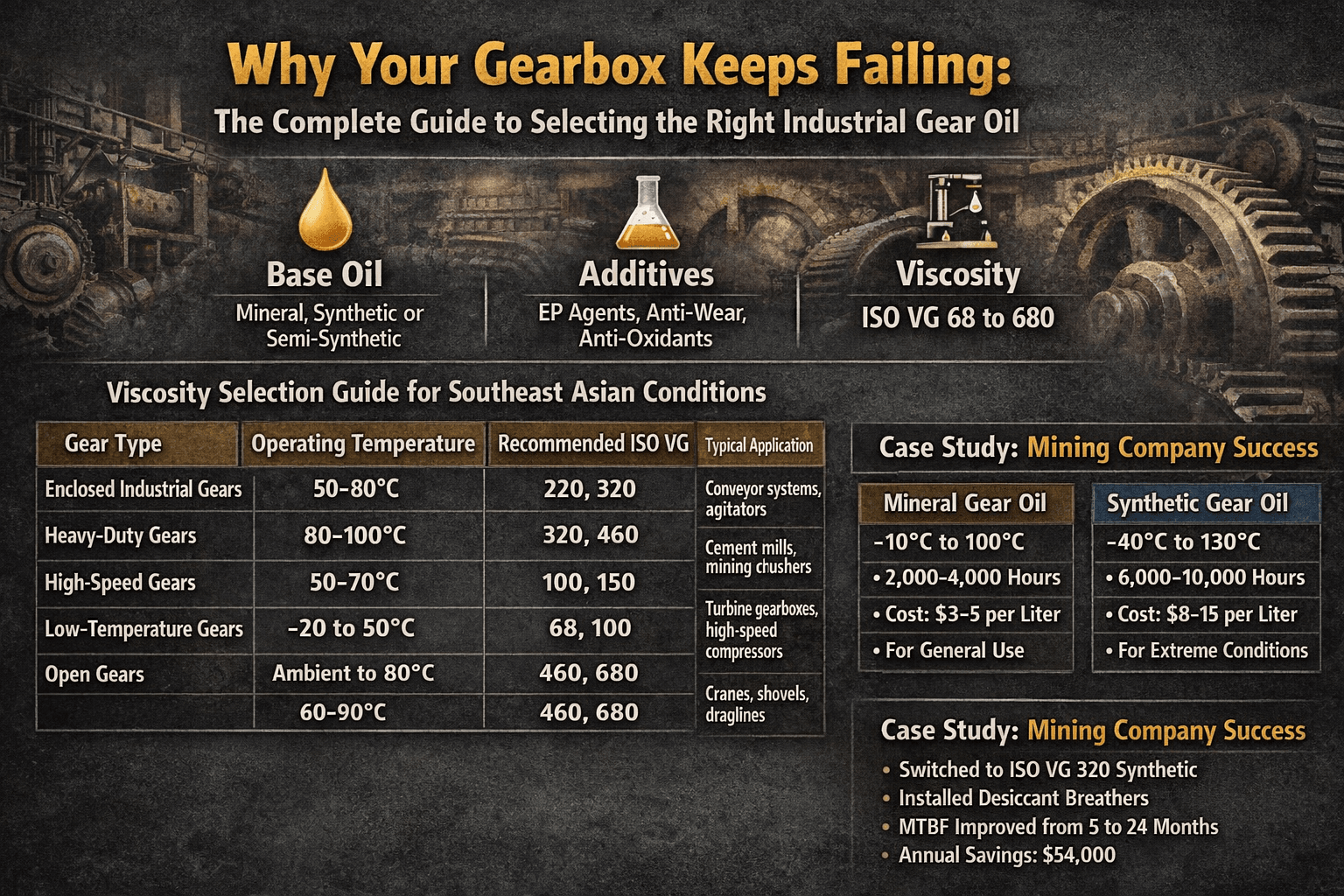
At its core, gear oil consists of three key components:
- Base Oil: The fluid foundation—mineral, synthetic, or semi-synthetic. This determines temperature range, oxidation stability, and film strength.
- Additives: Chemical boosters that enhance specific properties: Extreme Pressure (EP) agents, anti-oxidants, anti-foam agents, and corrosion inhibitors.
- Viscosity: The thickness or thinness of the oil, measured in centistokes (cSt) at 40°C or 100°C. This is the most critical specification for gear protection.
Each component matters. Get any of these wrong, and your gearbox will tell you—usually with a loud grinding noise followed by a very expensive silence.
1. Matching Viscosity to Your Application
The most common mistake we see in Southeast Asian facilities is selecting gear oil by price alone, without considering viscosity. Here’s what happens: a procurement manager buys the cheapest ISO VG 220 on the market, applies it to a high-speed gearbox, and within months, the bearings are shot.
The technical reality is straightforward: viscosity must match your operating conditions. Too thick, and the oil can’t flow into the gear teeth contacts. Too thin, and the film breaks down under pressure, leading to metal-to-metal contact and rapid wear.
viscosSelection Guide for Southeast Asian Conditions
| Gear Type | Operating Temperature | Recommended ISO VG | Typical Application |
|---|---|---|---|
| Enclosed Industrial Gears | 50-80°C | 220, 320 | Conveyor systems, agitators |
| Heavy-Duty Gears | 80-100°C | 320, 460 | Cement mills, mining crushers |
| High-Speed Gears | 50-70°C | 100, 150 | Turbine gearboxes, high-speed compressors |
| Low-Temperature Gears | -20 to 50°C | 68, 100 | Cold climate storage, outdoor equipment |
| Open Gears | Ambient to 80°C | 460, 680 | Cranes, shovels, draglines |
| 60-90°C | 460, 680 | Worm gearboxes, elevators |
The key principle: Higher temperatures require higher viscosity to maintain adequate film thickness. In Southeast Asia’s climate, where ambient temperatures regularly exceed 35°C, your gearbox runs hotter than a European or North American equivalent. Always select one ISO VG higher than the manufacturer’s recommendation if you’re operating above 40°C ambient.
The Real Cost of Getting Viscosity Wrong
A palm oil mill in Central Java learned this lesson the hard way. They were using ISO VG 220 gear oil in their digesters, which operated at 95°C during production. The oil was too thin to maintain a proper film. Within 18 months, they had replaced three gearboxes at $12,000 each—$36,000 in replacements alone, not counting downtime losses of approximately $85,000 in missed production.
After switching to ISO VG 320 with high viscosity index (VI 95+), gearbox life extended from 18 months to over 5 years. Annual savings: $28,000 in replacements plus approximately $65,000 in avoided downtime.
2. Understanding Additive Packages: EP, Anti-Wear, and More
Gear oil additives are the secret weapon that differentiates a premium product from budget oil. Here’s what you need to know:
Extreme Pressure (EP) Additives
EP additives react with metal surfaces under high pressure to form a protective sacrificial layer. This layer prevents metal welding and spalling when the gear teeth contact loads exceed the oil film strength.
Look for: Sulfur-phosphorus compounds, zinc dialkyldithiophosphate (ZDDP)
Why it matters: In heavily loaded industrial gears (above 500 N/mm² contact stress), EP additives are essential. Without them, the gear teeth will eventually weld together.
Anti-Wear (AW) Additives
AW additives provide boundary lubrication protection at moderate loads where EP isn’t needed. They form a protective film that reduces wear during start-stop operations and low-speed running.
Look for: ZDDP, phosphorus compounds
Why it matters: Most industrial gearboxes spend more time at low speeds than at full load. AW protection extends bearing and gear life during these critical periods.
Anti-Oxidants
Oxidants fight the chemical breakdown of oil when exposed to heat and oxygen. This is especially critical in Southeast Asia’s hot, humid climate.
Why it matters: In tropical conditions, oxidation accelerates dramatically. An oil that lasts 4,000 hours in Germany might fail in 1,500 hours in Indonesia without adequate anti-oxidants.
Anti-Foam Agents
Foam is the enemy of proper lubrication. Air bubbles in the oil compress under pressure, breaking the film and causing metal contact.
Why it matters: Gearboxes with splash lubrication or high agitation are prone to foaming. Without anti-foam agents, your oil quickly becomes useless.
3. Synthetic vs. Mineral: Making the Right Choice
The synthetic vs. mineral debate is simpler than marketing would have you believe. Here’s the practical breakdown:
Mineral Gear Oil
Refined from crude oil, mineral gear oil is the workhorse of industrial lubrication. It’s cost-effective and performs adequately in most applications.
- Temperature range: -10°C to 100°C (continuous)
- Lifespan: 2,000-4,000 operating hours
- Cost: Budget-friendly, approximately $3-5 per liter
- Best for: General industrial gearboxes, moderate loads, budget-conscious operations
Synthetic Gear Oil (PAO/Polyalphaolefin)
Engineered from chemically synthesized base stocks, synthetic gear oil offers superior performance in extreme conditions.
- Temperature range: -40°C to 130°C (continuous)
- Lifespan: 6,000-10,000 operating hours
- Cost: Higher, approximately $8-15 per liter
- Best for: Extreme temperatures, heavy loads, extended drain intervals, high-speed applications
When Synthetic Makes Sense in Southeast Asia
In our experience, synthetic gear oil is worth the premium in these situations:
- Operating temperatures above 100°C (near furnaces, hot processes)
- Very low temperature starts (-15°C or below in cold storage)
- Extended drain intervals (20,000+ hours between changes)
- Critical applications where downtime costs far exceed lubricant costs
- Food processing applications requiring NSF H1 certification
4. Common Mistakes We See in Southeast Asian Facilities
Mistake #1: Using Automotive Gear Oil in Industrial Gearboxes
This happens more often than you’d think. A maintenance manager grabs automotive gear oil (like the popular 80W-90 GL-5) because it’s available at the local parts shop. The problem? Automotive gear oil is designed for passenger vehicles with moderate loads and moderate pressures. Industrial gearboxes see pressures 3-5 times higher.
The fix: Always use industrial gear oil rated GL-4 or GL-5 (for industrial gearboxes) or better yet, follow ISO 6743-6 standards.
Mistake #2: Over-Filling the Gearbox
More oil means better lubrication, right? Wrong. Over-filling causes frothing, heat buildup, and seal stress. The oil gets churned into a foam that loses its lubricating properties.
The fix: Fill to the manufacturer’s recommended level—usually the center of the sight glass or the middle of the dipstick range.
Mistake #3: Ignoring Oil Temperature
In tropical climates, oil temperature is often 15-25°C higher than in temperate zones. The same oil that performs well in Germany fails prematurely in Jakarta.
The fix: Consider cooling options (heat exchangers, enlarged sumps) or select a higher viscosity grade. Monitor oil temperature with thermal probes.
Mistake #4: Mixing Different Brands
Different brands use different additive packages. Mixing can cause chemical reactions that create sludge and deposits.
The fix: Drain and flush before switching brands. If you must mix in an emergency, ensure both products meet the same ISO VG and API/AGMA specifications.
Mistake #5: Buying on Price Alone
The cheapest gear oil isn’t a bargain when it causes premature failures. Consider total cost of ownership—not just the price per liter.
The example: A Thai cement plant switched from a budget $3.50/L oil to a premium $7.50/L oil. The premium oil lasted 2.5x longer and the gearbox component life improved by 40%. The total annual cost actually dropped by $18,000.
5. Case Study: How One Mining Company Reduced Gearbox Failures by 75%
A coal mining operation in Kalimantan was experiencing gearbox failures every 4-6 months. Their maintenance costs were spiraling, and their production schedule was constantly disrupted.
The problem analysis:
- Ambient temperature: 32-38°C year-round
- Gearbox operating temperature: 95-110°C (too hot for standard oil)
- Contamination: High dust, regular water ingress from mine dewatering
- Current practice: Budget mineral ISO VG 220, changed every 6 months
Our recommendation:
- Switch to synthetic ISO VG 320 with EP additives (for extreme pressure protection)
- Install desiccant breathers (to prevent water ingress)
- Increase viscosity to ISO VG 460 for the most heavily loaded gearbox
- Extend drain interval to quarterly based on oil analysis
The results:
- Gearbox MTBF (Mean Time Between Failures): Extended from 5 months to over 24 months
- Annual lubricant cost: Increased from $8,000 to $18,000
- Annual repair/replacement cost: Dropped from $72,000 to $12,000
- Production uptime: Improved by 15%
- Total annual savings: Approximately $54,000
That’s the power of matching gear oil to application.
6. How to Choose: A Simple Decision Framework
When selecting industrial gear oil, ask yourself these questions:
- What is my operating temperature range? Match viscosity to your actual operating temperature, not room temperature.
- What are my load conditions? Heavily loaded gears need EP additives. Moderate loads may only need AW protection.
- How contaminated is my environment? Dust, water, and debris require specific protection packages.
- What are my drain interval requirements? Longer intervals favor synthetic oils.
- Do I have any certifications? Food processing needs NSF H1. Some industries require specific OEM approvals.
7. Oil Analysis: The Secret to Proactive Maintenance
The smartest operations don’t wait for failure. They use oil analysis to predict problems before they cause downtime.
Key Tests Every Facility Should Consider
| Test | What It Measures | Warning Threshold |
|---|---|---|
| Viscosity at 40°C | Oil thickness degradation | ±10% from new oil |
| Acid Number (TAN) | Oxidation acids forming | > 0.5 mg KOH/g |
| Water Content | Water contamination | > 0.1% (1000 ppm) |
| Particle Count (ISO 4406) | Contamination level | 2 code increases |
| ferrography | Wear particle analysis | Abnormal wear patterns |
Recommended frequency: Quarterly for critical gearboxes, bi-annually for general applications.
The investment: Approximately $80-150 per sample. Compare this to the cost of a single gearbox: $5,000-50,000.
The Maxtop Approach to Industrial Gear Oil
At Maxtop, we’ve spent years formulating gear oils specifically for Southeast Asian conditions. Our products are built to handle what your facilities actually face: tropical heat, monsoon humidity, heavy loads, and the challenge of keeping equipment running in demanding industries.
We offer:
- Industrial Gear Oils (ISO VG 68 to 680)
- Synthetic Gear Oils for extreme conditions
- Open Gear Lubricants for exposed applications
- Food-Grade Gear Oils (NSF H1) for food processing
- Custom formulations for specific OEM requirements
Every product is supported by technical data sheets, application guidance, oil analysis services, and our team of specialists who understand your industry.
We don’t just sell gear oil—we help you protect your equipment and reduce your total cost of ownership.
Ready to Optimize Your Gearbox Protection?
If you’re tired of unexpected gearbox failures, excessive maintenance costs, and equipment downtime, it’s time to talk.
Our technical team can review your current applications, analyze your operating conditions, and recommend the right gear oil solutions—products that actually match what your equipment needs.
What we can provide:
- Product recommendations based on your specific conditions
- Technical Data Sheets (TDS) and Material Safety Data Sheets (MSDS)
- Oil analysis program design and implementation
- Sample evaluation for your facilities
- Competitive pricing for bulk orders (drums, IBC tanks, totes)
- OEM and private label services for distributors
Because the right lubrication isn’t an expense. It’s an investment in equipment life, production reliability, and lower operating costs.
FAQ (Common Questions from Buyers and Engineers)
How often should I change my gear oil?
It depends on your operating conditions. A general guideline: change every 2,000-4,000 hours in moderate conditions, every 1,000-2,000 hours in hot, dirty, or heavily loaded conditions. However, oil analysis is the best indicator—when the oil properties reach your action thresholds, it’s time to change. Don’t rely on calendar dates alone.
Can I use automotive gear oil in my industrial gearbox?
No. Automotive gear oils (API GL-5) are designed for the moderate pressures found in vehicle differentials. Industrial gearboxes see pressures 3-5 times higher. Always use industrial-rated gear oil (API GL-4 or GL-5 for industrial, or follow ISO 6743-6 standards).
What’s the difference between EP and AW gear oil?
EP (Extreme Pressure) additives provide protection under high loads where metal-to-metal contact is likely. AW (Anti-Wear) additives protect under moderate loads and during start-stop operation. For heavily loaded industrial gearboxes, EP is recommended. For moderate loads, AW may be sufficient.
How do I know if my gear oil is failing?
Watch for: dark discoloration or browning, unusual odor (acidic or burnt smell), increased viscosity or the presence of emulsified water, rapid particle count increase, or unexplained gearbox noise. Regular oil analysis catches these problems before they cause failures.
Is more expensive gear oil worth it?
In most cases, yes. Premium gear oils with better additive packages, higher-quality base oils, and advanced formulations last longer, protect better, and reduce failures. As the case studies show, the cheaper oil often costs more in the long run through increased maintenance and downtime. Calculate total cost of ownership, not just purchase price.
What gear oil should I use for food processing equipment?
You need NSF H1 or USDA Food Grade certified gear oils. These are formulated for incidental food contact and are safe for use in food manufacturing environments. We can provide appropriate options for food processing applications across Southeast Asia.
Do you offer technical support and oil analysis?
Yes. Our technical team can help with product selection, application guidance, troubleshooting, and maintenance program development. We also partner with certified laboratories for comprehensive oil analysis programs tailored to your operations.
What’s the difference between ISO VG and SAE gear oil ratings?
ISO VG (Viscosity Grade) is the international standard (ISO 3448) for industrial gear oils. SAE (Society of Automotive Engineers) is primarily for automotive applications. For industrial gearboxes, follow ISO VG ratings—you’ll usually see it on the product label as “ISO VG 220” or similar.


