

Quenching oil vs Water quenching : Choosing the Right Medium for Heat Treatment

In heat treatment, the quench is the moment of truth. You have spent time and energy heating the workpiece to its austenitizing temperature; how you cool it determines whether you get a high-performance component or a piece of scrap metal.
The debate between Quenching Oil vs. Water Quenching isn’t just about cost—it is about the balance between hardness and distortion. While water is readily available, it is rarely the correct choice for precision industrial parts.
At Maxtop, we understand that heat treatment is about control, not just cooling. Here is a technical breakdown of how these two media compare and why upgrading to specialized quenching oils is often necessary for modern metallurgy.
Water Quenching: Aggression and Risk
Water is the oldest quenching medium, known for having the maximum cooling rate. It is cheap, non-flammable, and easy to source. For low-hardenability carbon steels (like AISI 1045) or when maximum hardness is the only metric that matters, water is efficient.
However, for precision manufacturing, water presents significant metallurgical risks:
- The Leidenfrost Effect (Vapor Blanket): When hot steel hits water, a steam vapor barrier instantly forms around the part. This insulates the metal, causing uneven cooling. When this barrier collapses, the cooling rate spikes violently.
- Thermal Shock: The transition from the vapor phase to the boiling phase in water is abrupt. This rapid contraction creates immense internal stress.
- Distortion and Cracking: Because water cools so aggressively, it frequently leads to warping, quench cracks, and dimensional instability, particularly in parts with complex geometries or varying cross-sections.
The Verdict: Water is fast, but it is unpredictable. It is generally unsuitable for high-alloy steels or parts requiring tight dimensional tolerances.
Quenching Oil: Controlled Cooling for Precision
Quenching oil is the industry standard for engineering steels, tool steels, and complex components. The primary advantage of oil over water is severity control.
Oil cools slower than water, but it does so more uniformly. A high-quality heat treatment oil, such as Maxtop Heat Treatment Series, manages the three stages of quenching (Vapor, Boiling, and Convection) to smooth out the thermal shock.
Why Metallurgists Prefer Oil:
- Reduced Distortion: The slower cooling rate in the convection phase allows the microstructure to transform into Martensite more evenly throughout the part. This minimizes internal stress and warping.
- Uniformity: Specialized additives in Maxtop oils facilitate the wetting of the metal surface, breaking the vapor blanket earlier and more consistently than water.
- Surface Finish: Water often causes oxidation and scaling. Oil protects the surface finish of the machined part during the quench.
Technical Comparison: Oil vs. Water
| Feature | Water Quenching | Maxtop Quenching Oil |
| Cooling Rate | Extremely Fast (Severe) | Controlled / Moderate |
| Risk of Cracking | High | Low |
| Distortion | Significant | Minimal |
| Suitable Materials | Low Carbon Steels | Alloys, Tool Steels, High-Carbon Steels |
| Boiling Point | 100℃ (Fixed) | High (Varies by viscosity/flash point) |
| Maintenance | Prone to bacteria/rust | Long bath life with oxidation inhibitors |
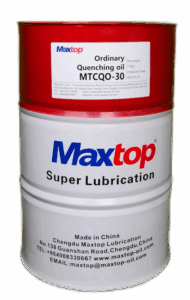
Common quenching oil 30
When to Switch from Water to Maxtop Oil
Many workshops start with water or polymer solutions to save on upfront costs, only to lose money on rejected parts and rework.
If your operation is facing the following issues, it is time to switch to a dedicated quenching oil:
• High Scrap Rates
• Inconsistent Hardness
• Complex Geometries
Maxtop Heat Treatment Oils are formulated with high-quality base oils and thermal stability additives. This ensures that the oil’s viscosity remains stable over thousands of cycles, providing the same cooling curve next year as it does today.
Conclusion
The choice between Quenching Oil vs. Water Quenching comes down to the cost of failure. Water is free, but cracked parts are expensive. For industrial applications where durability, dimensional accuracy, and surface integrity are non-negotiable, oil is the superior medium.
Don’t let the final step of your manufacturing process compromise the quality of your steel. Ensure your heat treatment line is optimized for consistency.
Explore Maxtop range of specialized quenching fluids here: View Maxtop Heat Treatment Oil Specifications