

Industrial Lubricants-How to Choose the Right Oil and Avoid Costly Mistakes

Choosing the right industrial lubricant is critical for equipment reliability, efficiency, and long-term cost control. Whether you are operating hydraulic systems, gearboxes, or high-temperature production lines, the wrong lubricant can lead to premature wear, downtime, and increased maintenance costs.
At MaxTop, we specialize in high-performance industrial lubricants designed to meet the evolving needs of modern industries—from heavy manufacturing to precision engineering.
This guide explains everything you need to know about industrial lubricant types, applications, and selection strategies.
What Are Industrial Lubricants?
Industrial lubricants are fluids or semi-solid substances used to reduce friction, protect against wear, transfer heat, and improve machine efficiency.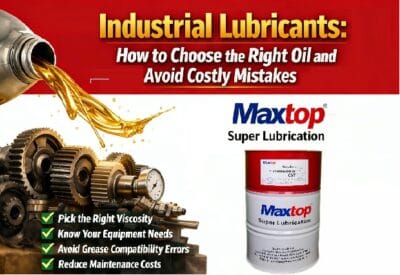
They are widely used in:
- Manufacturing plants
- Power generation
- Steel and cement industries
- Food processing equipment
- Automotive and heavy machinery
Types of Industrial Lubricants
1. Classification by Viscosity (ISO VG)
Viscosity is one of the most important factors when selecting a lubricant. The ISO VG (Viscosity Grade) system defines oil thickness at 40°C.
| ISO VG | Viscosity Level | Applications |
|---|---|---|
| 5–32 | Low viscosity | Chains, precision parts, high-speed systems |
| 68–150 | Medium viscosity | Hydraulic systems, general machinery |
| 220–680 | High viscosity | Heavy-duty gears, high-load environments |
Trend Insight:
Low-viscosity oils are increasingly used in conveyor systems due to their superior penetration and cleaner performance.
2. Classification by Base Oil
Mineral Oils
- Cost-effective
- Suitable for general industrial use
Synthetic Oils (PAO, POE, Silicone)
- Excellent thermal stability
- Longer service life
- Better performance in extreme temperatures
Bio-based Lubricants
- Environmentally friendly
- Biodegradable
- Ideal for sensitive environments
3. Classification by Application
- Hydraulic Oil – Power transmission
- Gear Oil – Protection under heavy load
- Grease – Long-lasting lubrication for bearings
- Metalworking Fluids – Cooling and cutting performance
- Transformer Oil – Electrical insulation and cooling
Grease Compatibility (Critical for Maintenance)
Mixing incompatible greases can cause serious equipment failure.
| Grease Type | Lithium | Calcium | Aluminum | Polyurea |
|---|---|---|---|---|
| Lithium | ✓ | ○ | ○ | ✗ |
| Calcium | ○ | ✓ | ○ | ○ |
| Aluminum | ○ | ○ | ✓ | ○ |
| Polyurea | ✗ | ○ | ○ | ✓ |
Best Practices:
- Never assume compatibility based on performance
- Avoid mixing polyurea greases
- Test before switching (ASTM standards recommended)
Why Low-Viscosity Lubricants Are Gaining Popularity
Modern lubrication technology challenges the old belief that “thicker is better.”
Key Benefits
1. Better Penetration
Reaches internal wear points such as pins and bushings quickly.
2. Cleaner Operation
Reduces dust and contamination buildup.
3. Lower Consumption
Minimizes dripping and waste in high-speed systems.
4. High-Temperature Stability
Synthetic ester oils can perform up to 250–300°C.
How to Choose the Right Industrial Lubricant
Selecting the right lubricant requires a systematic approach:
Step 1: Understand Your Equipment
- Operating temperature
- Load and pressure
- Speed
- Environmental conditions
Step 2: Follow OEM Specifications
Always match:
- ISO viscosity grade
- Additive requirements
Step 3: Evaluate Operating Conditions
- Continuous vs intermittent operation
- Exposure to water or contaminants
- Environmental regulations
Step 4: Consider Total Cost of Ownership
A cheaper oil may cost more in the long run.
Consider:
- Oil change intervals
- Maintenance costs
- Equipment lifespan
Recommended Lubricants by Application
| Application | Viscosity | Type |
|---|---|---|
| Hydraulic systems | ISO VG 32–68 | Anti-wear hydraulic oil |
| Gearboxes | ISO VG 150–460 | EP gear oil |
| Conveyor chains | ISO VG 5–32 | Synthetic chain oil |
| Bearings | ISO VG 68–220 | Grease |
| High-temperature systems | ISO VG 100–320 | Synthetic oil |
Why Choose MaxTop Industrial Lubricants?
At MaxTop, we combine advanced formulation technology with strict quality control to deliver reliable lubrication solutions.
Our Advantages:
- Consistent quality with ISO-certified production
- Wide product range covering all industrial applications
- Excellent thermal and oxidation stability
- Customized solutions for OEM and distributors
- Competitive pricing for global B2B partners
ontact MaxTop
Looking for a reliable industrial lubricant supplier?
MaxTop offers:
📩 Contact us today for:
- Product catalogs
- Technical data sheets (TDS)
- Samples and quotations