

Heat Transfer Fluid Explained: Functions, Standards, Maintenance, and Top Brands for Industrial Applications

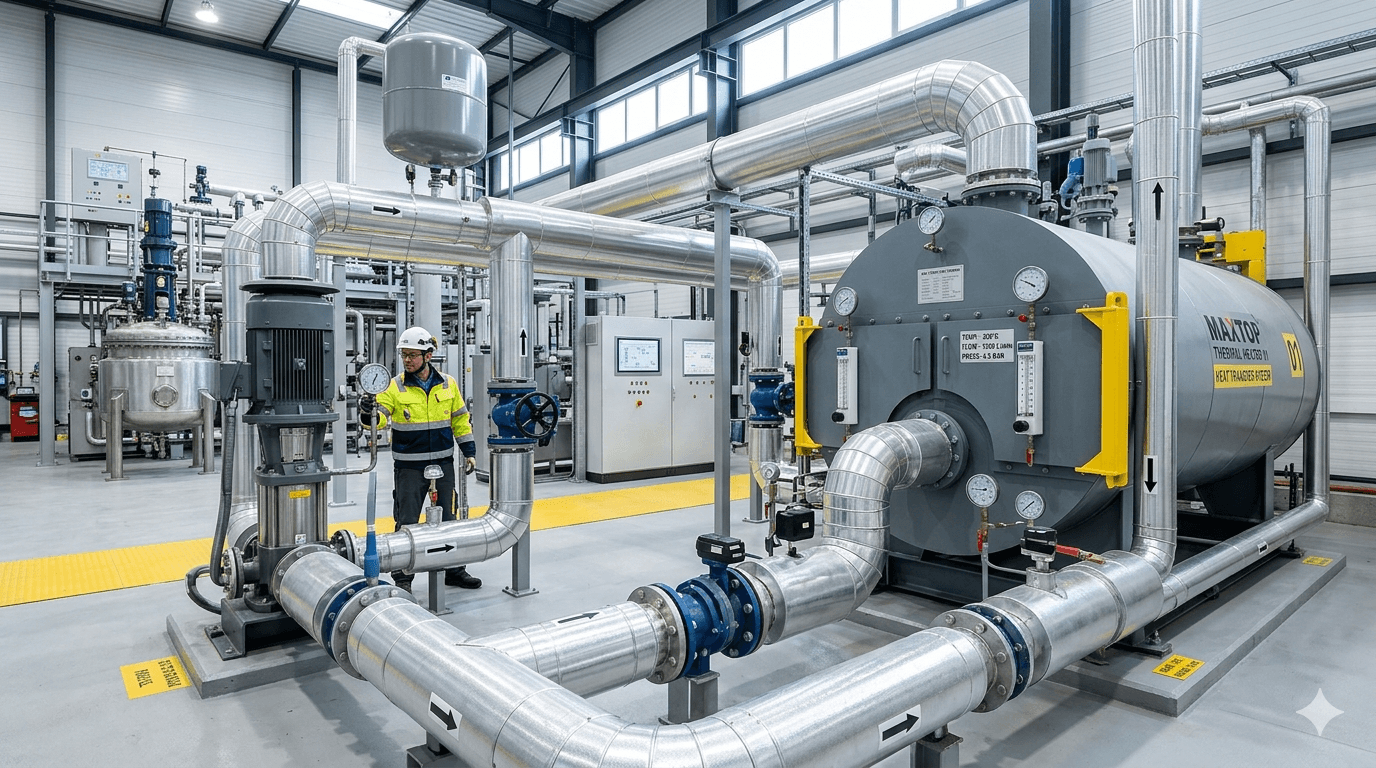
Published: April 2026 | Author: Maxtop Technical Team | Category: Heat Transfer Solutions
Table of Contents
- What is Heat Transfer Fluid?
- Why Heat Transfer Fluid Matters
- Types of Heat Transfer Fluids
- Key Specifications and Properties
- System Components and Maintenance
- Best Operating Practices
- Common Problems and Solutions
- How to Choose the Right Heat Transfer Fluid
- Frequently Asked Questions
- Conclusion
When your industrial process demands precise temperature control at 300°C or higher, water and steam simply cannot handle the job. That is where heat transfer fluids step in—silent workhorses that move thermal energy through countless manufacturing systems worldwide.
If you have ever wondered why some facilities run reliably for decades while others face constant breakdowns, the answer often lies in their heat transfer fluid management. Poor fluid selection or neglected maintenance does not just affect performance—it can cost factories thousands in emergency repairs and production losses.
In this comprehensive guide, you will discover everything you need to know about heat transfer fluids: from selecting the right thermal oil for your application to implementing maintenance practices that extend system life and reduce operational costs. Whether you are specifying fluids for a new installation or optimizing an existing system, this guide delivers the technical insights industry professionals rely on.
WHAT IS HEAT TRANSFER FLUID?
Basic Definition
Heat transfer fluid (HTF) is a specialized liquid medium designed to transport thermal energy from one point to another in closed-loop heating or cooling systems. Unlike water, which boils at 100°C and freezes at 0°C, thermal fluids operate effectively across a much wider temperature range—from cryogenic applications to systems exceeding 400°C.
How Heat Transfer Fluids Work
In a typical thermal fluid system, the fluid:
- Absorbs heat from a heating source (electric heater, furnace, or waste heat)
- Circulates through pipes to the process equipment
- Transfers thermal energy to the application
- Returns to the heater for re-heating in a continuous cycle
This closed-loop design means the fluid never contacts the atmosphere, preventing oxidation and contamination that plague open systems.
The Difference Between Thermal Oil and Heat Transfer Fluid
| Term | Application | Temperature Range | System Type |
|---|---|---|---|
| Thermal Oil | Liquid-phase heating systems | -20°C to 350°C | Closed-loop circulation |
| Heat Transfer Fluid | Broader category including thermic fluids, Dowtherm, and thermal oils | Varies by formulation | Closed or semi-closed |
WHY HEAT TRANSFER FLUID MATTERS
Economic Impact
Consider this: a single hour of unplanned downtime in a chemical plant costs an average of $250,000 in lost production. Many of these emergencies trace back to heat transfer fluid degradation—thermal cracking, oxidation, or contamination that leads to system failure.
Performance Requirements
Modern industrial processes demand:
- Precise temperature uniformity (±1°C control in many processes)
- Consistent viscosity across operating range for reliable flow
- Thermal stability to resist decomposition at high temperatures
- Long service life to minimize replacement frequency and costs
Safety Considerations
Heat transfer fluids operate at temperatures that pose serious safety risks. Understanding flash point, fire point, and thermal stability is not optional—it is essential for protecting personnel and equipment.
TYPES OF HEAT TRANSFER FLUIDS
Mineral-Based Thermal Oils
| Property | Specification |
|---|---|
| Composition | Refined petroleum base with additives |
| Temperature Range | -10°C to 320°C |
| Typical Lifespan | 2-5 years with proper maintenance |
| Cost | Lower initial investment |
Best for: General industrial heating applications below 300°C, systems where budget constraints are primary concern
Synthetic Heat Transfer Fluids
| Property | Specification |
|---|---|
| Composition | Engineered chemical compounds (biphenyl/diphenyl ether blends, PAO-based) |
| Temperature Range | -30°C to 400°C |
| Typical Lifespan | 5-10 years with proper maintenance |
| Cost | Higher initial investment, lower total cost of ownership |
Best for: High-temperature applications, processes requiring extended fluid life, systems demanding superior thermal stability
Specialty Fluids
| Type | Application | Key Advantage |
|---|---|---|
| Food-Grade Fluids | Food processing, pharmaceuticals | FDA-approved, non-toxic |
| Quenching Oils | Metal heat treatment | Controlled cooling rates |
| Cryogenic Fluids | Extreme cold applications | Operation below -150°C |
KEY SPECIFICATIONS AND PROPERTIES
Critical Performance Parameters
When evaluating heat transfer fluids, focus on these specifications:
| Parameter | Why It Matters | Typical Range |
|---|---|---|
| Viscosity @ 40°C | Affects pumpability and flow rate | 15-100 cSt depending on grade |
| Thermal Expansion | Determines expansion tank sizing | 0.0007-0.0009 per °C |
| Flash Point | Safety indicator for fire risk | 150-300°C |
| Autoignition Temperature | Temperature at which fluid self-ignites | 350-500°C |
| Thermal Stability | Resistance to thermal decomposition | Expressed as hours to 10% decomposition |
Thermal Oil Selection Chart
| Process Temperature | Recommended Fluid Type | Maximum Recommended Bulk Temperature |
|---|---|---|
| Up to 250°C | Mineral oil | 280°C |
| 250-300°C | High-performance mineral | 330°C |
| 300-350°C | Synthetic blend | 380°C |
| Above 350°C | Synthetic (biphenyl/diphenyl ether) | 400°C |
Key Decision Factors
Before selecting a heat transfer fluid, answer these questions:
- What is the maximum operating temperature?
- What temperature uniformity is required?
- Is the system open or closed-loop?
- What are the heating and cooling cycles?
- Are there food, pharmaceutical, or cosmetic contact requirements?
- What is the expected service life?
SYSTEM COMPONENTS AND MAINTENANCE
Essential System Components
Every heat transfer fluid system requires these core elements:
1. Heater (Thermal Oil Heater)
| Component | Specification | Maintenance Priority |
|---|---|---|
| Heating coils | Must maintain design flow velocity through coils | Critical |
| Burner/electric elements | Proper combustion or electrical input | High |
| Heat exchanger surfaces | Free from fouling and scaling | Medium |
2. Circulating Pump
Maintenance checklist:
- Check seal condition regularly
- Monitor bearing temperature
- Verify flow rate matches design specifications
- Inspect coupling alignment
3. Expansion Tank (Expansion Vessel)
| Issue | Consequence | Prevention |
|---|---|---|
| Low fluid level | Pump cavitation, system failure | Maintain proper fill level |
| High temperature | Accelerated oxidation, steam formation | Keep below 60°C |
| Air exposure | Foam formation, corrosion | Use nitrogen blanket above 250°C |
4. Filtration System
Proper filtration extends fluid life significantly:
| Filter Type | Location | Function | Typical Rating |
|---|---|---|---|
| Strainer | Pump suction | Remove large particles | 150+ micron |
| Side-stream filter | Bypass loop | Continuous fine filtration | 10 micron |
| Full-flow filter | Pressure side | Final protection | 3-10 micron |
Regular Maintenance Schedule
Weekly Checks
- Expansion tank fluid level
- Pump pressure and flow rate
- Heater outlet temperature
- Visible leaks or unusual odors
Monthly Checks
- Filter differential pressure
- Pump bearing temperature
- Electrical connections
- Control system calibration
Quarterly Analysis
| Test | Method | Acceptance Criteria |
|---|---|---|
| Viscosity | ASTM D445 | Within ±10% of new fluid |
| Acid number | ASTM D664 | <0.3 mg KOH/g |
| Water content | Karl Fischer | <200 ppm |
| Flash point | ASTM D92 | >150°C (degradation if drops 20°C+) |
BEST OPERATING PRACTICES
Startup Procedure
Follow this sequence every time you start a thermal oil system:
Step 1: Pre-start verification
- Confirm fluid level in expansion tank
- Verify all valves in correct position
- Check that drain valves are closed
- Ensure pump rotation is correct
Step 2: Circulate cold fluid
- Start circulation pump before heating
- Verify flow through all system branches
- Check for leaks at fittings and flanges
Step 3: Gradual heating
- Increase temperature in 20-25°F (11-14°C) increments
- Monitor pump pressure throughout
- At 100°C: hold for 30 minutes to drive off moisture
- Progress to operating temperature over 2-4 hours
Step 4: System check
- Verify temperature uniformity at all points
- Confirm control system is maintaining setpoint
- Document startup parameters
Shutdown Procedure
Proper shutdown protects your system:
- Reduce load gradually — do not shut off heat suddenly
- Continue circulation until bulk fluid temperature drops below 100°C
- Maintain circulation until temperature reaches 60°C
- Stop pump only after fluid has cooled sufficiently
- Inspect for any leaks that developed during operation
⚠️ Critical warning: Never stop the circulation pump while the heater is still hot. This can cause localized overheating and coke formation on heating surfaces.
Operating Temperature Guidelines
| Parameter | Maximum Bulk Temperature | Reason |
|---|---|---|
| Mineral oils | 280-300°C | Thermal stability limit |
| Synthetic fluids | 350-380°C | Depends on formulation |
| Always | 20-30°C below fluid boiling point | Safety margin |
COMMON PROBLEMS AND SOLUTIONS
Problem 1: High Discharge Pressure
| Cause | Diagnosis | Solution |
|---|---|---|
| Clogged strainer | Differential pressure > 15 psi | Clean or replace strainer |
| Cold, viscous fluid | Occurs during cold start | Allow proper warm-up |
| Pump wear | Gradually increases over time | Inspect/rebuild pump |
| Closed valve | Sudden onset | Check valve positions |
Problem 2: Foaming
| Cause | Diagnosis | Solution |
|---|---|---|
| Water contamination | Milky appearance, bubbles | Drain and dehydrate system |
| Air entrainment | Pump suction leak | Find and seal air leak |
| Contamination | Sudden onset with new fluid | Flush and refill |
Problem 3: Sludge and Deposits
| Cause | Diagnosis | Solution |
|---|---|---|
| Thermal cracking | Dark particles, increased viscosity | Fluid analysis, potential replacement |
| Oxidation | Varnish-like deposits | Check expansion tank operation |
| Contamination | Foreign particles | Improve filtration |
Problem 4: Foul Odor
| Cause | Diagnosis | Solution |
|---|---|---|
| Overheating | Burnt smell | Check temperature controllers |
| Oxidation | Sour/acid smell | Test acid number, consider replacement |
| Contamination | Unusual chemical smell | Identify contamination source |
Problem 5: Reduced Heating Capacity
| Cause | Diagnosis | Solution |
|---|---|---|
| Coked heater surfaces | Slow response to setpoint changes | Mechanical cleaning or heater replacement |
| Fouled pipes | Gradual decline over years | Chemical cleaning or system replacement |
| Low flow rate | Check pump performance | Verify pump settings and condition |
HOW TO CHOOSE THE RIGHT HEAT TRANSFER FLUID
Selection Decision Matrix
| Application Type | Recommended Fluid | Key Consideration |
|---|---|---|
| Plastics processing | Mineral or synthetic blend | Temperature range, cost |
| Chemical processing | Synthetic | Thermal stability, fluid life |
| Asphalt heating | High-temperature mineral | Maximum temperature, carbonization resistance |
| Food processing | Food-grade synthetic | FDA compliance, non-toxicity |
| Pharmaceutical | USP-grade fluids | Purity, regulatory compliance |
| Composite manufacturing | Synthetic | Wide temperature range, thermal stability |
Questions to Ask Your Supplier
Before purchasing heat transfer fluid, request:
- Technical data sheet — Full specifications including viscosity, flash point, thermal stability data
- Material Safety Data Sheet (MSDS) — Safety handling requirements
- Thermal stability test results — Hours to 10% decomposition at operating temperature
- Reference installations — Similar applications in your industry
- Technical support — Can they help with system design and troubleshooting?
Maxtop Heat Transfer Solutions
At Maxtop, we provide:
- Premium thermal oils for applications up to 320°C
- High-performance synthetic fluids for temperatures to 400°C
- Food-grade formulations for processing applications
- Technical support from experienced engineers
- Fluid analysis services to monitor system health
Contact our technical team for customized recommendations for your specific application.
FREQUENTLY ASKED QUESTIONS
Q1: How often should heat transfer fluid be replaced?
A: There is no universal interval. Fluid life depends on operating temperature, system design, and maintenance practices. With proper operation and regular fluid analysis, mineral oils typically last 3-5 years, while synthetic fluids can exceed 8-10 years. Replace when fluid properties exceed acceptable limits—increased viscosity (>15% from new), elevated acid number (>0.3 mg KOH/g), or visible degradation.
Q2: Can I mix different heat transfer fluids?
A: Generally not recommended. Mixing fluids with different base chemistries can cause compatibility issues, reduced performance, and accelerated degradation. If you must change fluids, completely drain and flush the system before adding new fluid. Consult with your fluid supplier about specific compatibility.
Q3: What causes heat transfer fluid to turn dark?
A: Darkening indicates thermal or oxidative degradation. Minor color changes (light amber to darker amber) are normal. Severe darkening, particularly with sludge formation, signals significant degradation requiring fluid analysis and likely replacement.
Q4: How do I remove water from my thermal oil system?
A: Water contamination typically enters through leaks or condensation. To remove it:
- Heat system gradually to 100-110°C
- Maintain at this temperature with circulation for 2-4 hours
- Monitor expansion tank for steam release
- Verify water removal with Karl Fischer test
Q5: What is the difference between vapor phase and liquid phase heating?
A:
| System Type | Temperature Range | Application |
|---|---|---|
| Liquid phase | Up to 350-400°C | Most common, simpler systems |
| Vapor phase | Uses fluid boiling/condensing cycle | Specific high-temperature applications |
Most industrial heat transfer applications use liquid-phase systems.
Q6: How do I know if my heater is coked?
A: Signs of coking include:
- Slow temperature response
- Higher than normal heater outlet temperature
- Increased fuel/energy consumption
- Uneven heating across the system
Coking typically results from operating with low flow rate through the heater or running at temperatures above fluid recommendations.
INDUSTRY-SPECIFIC APPLICATIONS
Chemical and Petrochemical Industry
Heat transfer fluids serve critical functions in chemical processing:
| Process Application | Temperature Requirement | Recommended Fluid | Special Considerations |
|---|---|---|---|
| Distillation | 150-300°C | Mineral or synthetic | Thermal stability critical |
| Polymerization | 200-350°C | Synthetic | Long service life required |
| Extraction | 50-150°C | Mineral | Cost-effective solution |
| Reactor heating | 250-400°C | High-performance synthetic | Precise temperature control |
Case example: A Thai chemical manufacturer reduced their thermal fluid replacement costs by 40% after switching to a synthetic fluid with superior thermal stability, extending service life from 18 months to 4 years.
Plastics and Rubber Manufacturing
| Equipment | Typical Temperature | Fluid Type | Service Interval |
|---|---|---|---|
| Injection molding | 200-300°C | Mineral/synthetic blend | 2-3 years |
| Extrusion | 250-350°C | Synthetic | 3-5 years |
| Compression molding | 150-250°C | Mineral | 2-4 years |
| Rubber mixing | 100-180°C | Mineral | 2-3 years |
Key challenge: Plastics processing requires precise temperature uniformity (±2°C) to ensure product quality. Temperature variations cause defects, warping, and inconsistent properties.
Food and Pharmaceutical Industries
These industries face unique requirements:
| Requirement | Challenge | Solution |
|---|---|---|
| FDA compliance | Food contact regulations | Food-grade thermal fluids |
| Non-toxicity | Personnel safety | Synthetic food-grade formulations |
| Clean operation | No contamination | Closed systems, regular filtration |
| Temperature precision | Product quality | High-performance fluids with stable viscosity |
Food-grade thermal fluids are formulated with white mineral oil bases and approved additives. They must meet FDA 21 CFR regulations for incidental food contact.
Asphalt and Road Construction
| Application | Temperature Range | Fluid Type | Key Performance |
|---|---|---|---|
| Asphalt heating | 150-200°C | High-performance mineral | Carbonization resistance |
| Tank heating | 100-180°C | Mineral | Cost-effective |
| Pipeline tracing | 60-120°C | Mineral | Long circulation paths |
Critical consideration: Asphalt heating systems must prevent coking, which clogs pipes and reduces heating efficiency. Choose fluids with high thermal stability and implement proper filtration.
COST ANALYSIS AND ROI CONSIDERATIONS
Total Cost of Ownership Model
When evaluating heat transfer fluid options, consider the total cost over the fluid service life:
| Cost Component | Mineral Oil | Synthetic Fluid |
|---|---|---|
| Initial fluid cost | $3-5/kg | $8-15/kg |
| System capacity | 5,000 liters | 5,000 liters |
| Initial fill cost | $15,000-25,000 | $40,000-75,000 |
| Service life | 3 years | 8 years |
| Replacement frequency | 3× in 10 years | 1.25× in 10 years |
| Energy efficiency | Baseline | 5-10% improvement |
Key insight: Despite higher initial cost, synthetic fluids often provide comparable or lower total cost of ownership due to longer service life and improved efficiency.
SAFETY STANDARDS AND REGULATIONS
Industry Standards
Heat transfer fluid systems must comply with relevant standards:
| Standard | Scope | Key Requirements |
|---|---|---|
| ASME Section VIII | Pressure vessels | Design pressure, materials, fabrication |
| API 556 | Fired heaters | Heater design, safety systems |
| NFPA 86 | Ovens and furnaces | Safety interlocks, purge requirements |
| OSHA 1910.106 | Flammable liquids | Storage, handling, ventilation |
Safety Equipment Requirements
| Equipment | Purpose | Inspection Frequency |
|---|---|---|
| Expansion tank | Accommodates thermal expansion | Annual visual inspection |
| Pressure relief valves | Prevents overpressure | Per valve manufacturer (typically annual) |
| High-temperature alarms | Warns of abnormal conditions | Monthly test |
| Emergency shutdown | Stops system in emergency | Quarterly test |
| Leak detection | Identifies fluid leaks | Continuous monitoring recommended |
FUTURE TRENDS IN HEAT TRANSFER TECHNOLOGY
Emerging Developments
The heat transfer industry continues to evolve:
| Technology | Development | Application |
|---|---|---|
| Nanofluids | Metal oxide nanoparticles improve heat transfer | Higher efficiency systems |
| IoT monitoring | Real-time fluid condition monitoring | Predictive maintenance |
| Bio-based thermal fluids | Renewable source alternatives | Sustainability-focused applications |
| Improved synthetics | New chemical formulations | Extended temperature range |
CONCLUSION
Selecting and maintaining the right heat transfer fluid is not just a technical decision—it is a business decision that impacts production reliability, operating costs, and equipment longevity. In Southeast Asia demanding industrial environment—where plastics manufacturers in Vietnam push temperatures to their limits, chemical plants in Thailand operate around the clock, and mining operations in Indonesia require absolute reliability—the difference between thriving and struggling often comes down to thermal management.
Key takeaways:
- Match fluid to application — Consider temperature, required service life, and budget. The cheapest fluid is not always the most economical over its service life.
- Follow proper startup/shutdown procedures — Gradual heating and cooling protect your system from the thermal stresses that cause coking, cracking, and premature failure.
- Implement regular maintenance — Fluid analysis catches problems before they become failures. A $200 analysis can prevent a $50,000 emergency.
- Work with experienced suppliers — Technical support pays dividends in system reliability. Maxtop engineering team has decades of combined experience across Southeast Asia.
- Design for efficiency from day one — Proper system design reduces long-term operating costs. The investment in engineering pays back through energy savings.
- Train your operators — Most thermal fluid problems stem from improper operation. Invest in operator training to protect your equipment.
The Maxtop Advantage
With over a decade of experience serving industrial customers across Southeast Asia—Indonesia, Thailand, Vietnam, Malaysia, and the Philippines—Maxtop understands the demanding requirements of thermal fluid applications. Our products are engineered to deliver:
- Superior thermal stability — Extended fluid life means reduced replacement frequency and lower costs
- Wide operating temperature range — Versatile solutions from -20°C to 400°C for any application
- Exceptional pumpability — Reliable flow at all operating conditions, from cold startup to peak temperature
- Long service life — Reduced downtime and replacement frequency means more production time
- Regional support — Our technical team understands Southeast Asian conditions and requirements
Ready to Optimize Your Heat Transfer System?
Maxtop provides comprehensive heat transfer solutions for industrial applications throughout Southeast Asia:
- Premium thermal oils formulated for demanding applications up to 320°C
- High-performance synthetic fluids for temperatures to 400°C
- Food-grade formulations meeting FDA requirements for processing applications
- Expert technical support from qualified engineers with regional experience
- Fluid analysis services to monitor system health and extend fluid life
- System design assistance for new installations and upgrades
Contact our technical team today to discuss your heat transfer requirements. We will help you select the right fluid, optimize your system design, and develop a maintenance program that maximizes performance and minimizes operational costs.
Whether you are operating in Thailand chemical processing sector, Vietnam plastics industry, Indonesia mining operations, Malaysia rubber manufacturing, or the Philippines food processing facilities, Maxtop has the products and expertise to support your success.
Contact Maxtop:
- Website: www.maxtop-oil.com
- Email: maxtop@maxtop-oil.com
- Technical Support: Global support provision
This article is for informational purposes. Consult with qualified engineers and follow OEM recommendations for specific applications. Fluid specifications and performance may vary based on operating conditions and system design.
