

Blackened Knitting Machine Needle Cylinders? Here’s the Real Cause and the Tested Solution

What causes the needle cartridge of a knitting machine to turn black with oil?
Maxtop Corporation investigated the problem of blackening of needle cylinders in knitting machine oil and found that it was mainly caused by additives. After hundreds of tests, they successfully developed a non-blackening knitting machine oil and proposed suggestions such as optimizing additives, improving needle cylinder surface treatment, and strengthening maintenance.
In-depth investigation and solutions to the causes of blackening of knitting machine oil syringes
I. Research Background
The problem of knitting machine oil turning black on needle cylinders has long plagued the industry, affecting not only equipment performance but also threatening product quality. Maxtop was determined to overcome this challenge and conducted systematic formula research and simulation testing.
II. Detailed Explanation of the Experimental Process
- Base oil selection: We carefully select colorless and odorless Group II base oils that have undergone high-pressure hydrotreating to ensure high quality.
- Additive formulation: Various types of additive compositions are carefully prepared and heated and blended with base oil to form finished knitting machine oils with different formulation systems.
- Simulation test: The knitting machine oils of each formula were placed in test tubes, and mold steel bars, copper wires and four different types of yarns were added as catalysts to simulate a high-temperature working environment and heated at 120°C for 48 hours.
- Observations and Records: High-temperature testing revealed no significant changes on the copper wire surface, while the mold steel surface showed differentiation. One sample corroded and turned black, with corrosion intensifying over time; the other sample remained stable. Furthermore, the discoloration of the metal surfaces varied depending on the formulation system. The different surface colors produced by using the same base oil but different additives indicate that the blackening of the syringe was primarily due to issues with the additives.
- In-depth analysis: Considering that the surface temperature of knitting machine needle cylinders is usually below 80℃, we infer that the black needle cylinder phenomenon is mainly due to the combined effect of the lubricating extreme pressure components in the additives, especially the catalytic effect of active sulfur on the metal surface, as well as the complex reactions of surfactants, rust inhibitors, antioxidants, detergents and other components.
III. Experimental Results
After hundreds of high-temperature intensive simulation tests, Maxtop successfully selected a knitting machine oil that will not cause the needle cylinder to turn black. This oil exhibits excellent performance in emulsification, lubrication, anti-wear, and resistance to yellowing.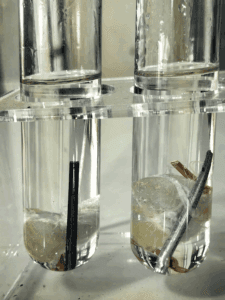
IV. Recommendations and Measures
Based on the findings of this study, we offer the following recommendations:
- Additive formulation optimization: Develop new additives to reduce the risk of corrosion to metal surfaces.
- Improved syringe surface treatment: The syringe is specially treated to enhance its corrosion resistance.
- Strengthen equipment maintenance: Develop a regular maintenance plan, replace damaged syringes in a timely manner, and ensure production efficiency.
- It is recommended to purchase Maxtop knitting machine oil to avoid the knitting machine oil causing the needle cylinder to turn black.
V. Conclusion
Through this in-depth research, Maxtop not only revealed the main reasons for the blackening of knitting machine oil cylinders, but also provided the industry with practical solutions. We will continue to dedicate ourselves to technological innovation and contribute to the sustainable development of the knitting equipment industry.